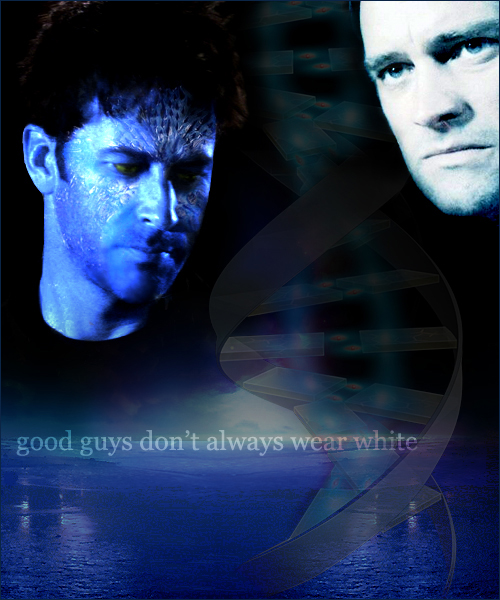
Email: nel_ani@yahoo.se I started writing this fic in the evenings in Malta, homesick and computerless, and it was a great comfort to me. I hope you'll enjoy reading it as much as I enjoyed writing it (when it wasn't eating my brain, that is). MANY thank yous to Danvers, without who I would have given up after about 2000 words, and who cheered me on and came with suggestions and generally made me feel good about the fic. Thanks to Kylie Lee, who went above and beyond, even when busy as hell, and really reorganized the story and made it whole, and not fragmented scenes put together. And last but not least, Suz, who I can always trust to give me a honest opinion. You guys rock. Added notes: If you prefer
you can go here and get a javascript zapper that's extremely easy to use. Basically, you just drag it to your toolbar (if you're using Firefox; it works for other browsers as well, I'm just not sure if it's the same procedure) and click it whenever you want to strip the website of colors. There are a bunch of other plugins there as well, so if you feel like it, you can install all functions at once. I. Hindsight was twenty-twenty. Unfortunately, the same thing had yet to be said for Rodney's ability to read people. The man was tall, dark, and, yes, all right, handsome, and if there was anything Rodney despised, it was feeling like a cliché and going for something like that. Though, honestly, it wasn't the tall, dark, and handsome part that had him tripping into the entire mess. It was that tall and dark had the nerve to plop down at the opposite side of the table, where Rodney was minding his own business while eating a burger. "Hi," the stranger had said, flashing him an easy smile. "I'm John." He signaled the server for a beer. Rodney glared at the person stealing his leg space. "How nice for you," he replied, "I'm eating." "Now, is that any way to talk to the guy who's about to buy you a beer?" Rodney's eyes narrowed. "Are you a prostitute? 'Cause believe it or not, I'm not actually that desperate." John's smile widened. "What would you do if I said that I was?" Rodney considered that for a moment, then took another bite. "Finish my burger." "A man with priorities. I like that." He casually rubbed his foot up and down Rodney's shin. The chair screeched as Rodney shoved it back and stood. "Are you insane?" he hissed. "I told you, not that desperate." John, the bastard, laughed. "Sorry, sorry, sit down." Rodney glared suspiciously. "Not a hooker," John said earnestly. "Cross my heart." He made an X gesture over his chest. "If I want to be harassed, I can get enough of that at work," Rodney snapped. John sobered. "Seriously, I'm sorry. I didn't come here to make you uncomfortable." His mouth turned up at the corners. "You just made it too tempting." Against his better judgment, Rodney sat again, quickly eating the last of his burger, while John seemed to be paying an inordinate amount of attention to Rodney's mouth. "If you didn't come here to harass me, why did you come here?" Rodney asked, starting in on the fries. John shrugged. "I just felt like some company." "Some company?" Rodney said skeptically. "Yes, some company," John repeated, only the word company seemed significant somehow, and Rodney frowned before his eyebrows shot up. "Oh! Oh, company!" He frowned again. "You're looking for company here? You do realize that there are bars for these kinds of things." John shrugged and gave him a teasing smile. "I saw you through the window and figured it was worth a shot." Rodney stared hard at him, trying to figure out if the guy was some kind of psychotic stalker, or just someone who wanted . . . company. "You saw me through the window." "What can I say." John's eyes drifted to his mouth again. "You're my type." Rodney blinked. "You found me so irresistible that you came in here to harass me and offer me sexual favors for free," he stated flatly. John's smile widened. "Well, I'm not sure I'd say 'sexual favors.' I was hoping it might be mutual." That's how Rodney ended up making out with a complete stranger behind his favorite burger bar, John slowly licking the taste of fries out of his mouth, Rodney tasting the beer on John's breath. American beer, sure, but all in all, he couldn't complain. That was before it all went spectacularly and horribly wrong. John was pressed close to him, doing wonderful, interesting things with his tongue, when he suddenly pulled back. "Hey," he said, looking at Rodney, and all of a sudden something was different, only Rodney didn't know what. "What?" Rodney said, trying to focus on what was different about John. John's mouth twisted down a bit. "This is nothing personal, okay?" Rodney was going to ask him what wasn't personal when John pressed a gun to his chest and Rodney had just enough time to see John's face change, eyes turning yellow and skin turning blue, before he scrabbled backward through the wall, stumbling as he reentered the building (the kitchen, as it happened), staring in shock as the plaster on the wall burst outward from the impact of the bullets. He stayed lighter instead of solidifying, and the bullets passed through him with just a tickle. Moving aside, he looked around, seeing the shocked faces of the chef and one of the waitresses. He had a brief thought of regret that he wouldn't be able to eat here again. Then he ran through the wall, into the dining room, and out to the street. *** The first time the powers kicked in, when he was about fifteen, it had been excruciating. After, Rodney could never remember what he was doing before it started, no matter how hard he tried. It was ironic, because he'd give anything to forget the rest: the sudden darkness and sense of vertigo. How breathing suddenly became hard. Confusion, panic, and then pain: every cell of his body on fire, and he would have screamed if there had been air for it. Now he knew that the pain had come from his body turning denser, making him feel the sensation of rock sliding through him as he fell through the ground. And the breathing—well, there was no way his body could use such small particles of air while he was out of phase. He still didn't know how he'd survived, though, whether it had been instinct or sheer luck. Had he just kept falling, he would have suffocated, and had he in panic tried to solidify, he would have died instantly, merging with the rock. Somehow, he'd managed to turn dense to a point where he could claw his way back up again, lungs screaming for air and his body on fire. When it finally stopped, when there was light and air and no pain, just Jeannie's panicked screaming, all he'd been able to do was curl into a ball, eyes screwed shut, not daring to move. He didn't want to sink again. *** He had to report the diner incident, although he was hazy about the details—like, exactly how "John," if that was his real name, which Rodney doubted, had lured him out. Elizabeth and Radek didn't need to know that he'd been making out with a strange guy in an alley, hoping to get lucky. Elizabeth promptly locked him up—well, confined him to quarters, anyway, pending his removal to a safe house. She assured him it was temporary, and he had to admit that she had a point: the timing of the attack was too much of a coincidence. He'd probably been targeted because of the research. He was sitting in an armchair at the research complex, reading Verne's Journey to the Center of the Earth and scowling, when Radek entered the room. Rodney scowled at Radek as well. If there was one thing that made him more cranky than being locked up (fine, technically speaking, he could leave whenever he wanted, be it through the door or through a wall, but that was completely beside the point), it was reading books with poor science, although he remembered enjoying it as a kid. "Well, if it isn't Mr. Secret Agent," Rodney snapped. "I see your mood hasn't improved," Radek observed, closing the door behind him. He reflexively pushed his glasses up his fuzzy blue nose. "Wow," Rodney said feelingly, "you really must be smarter than you look." Radek gave him a quelling look. "Yes, I know that you don't like this, but what would you suggest? That we just ignore our contacts?" Rodney hated it when Radek was reasonable. "I hate it when you're being reasonable." Radek smiled at that. "Yes, I know." Rodney had known Radek for a couple of years now. By all accounts, they should have hated each other's guts, rivals in the same field as they were, not to mention their disastrous first meeting (Rodney going, "Holy shit, you're blue!"). Rodney wouldn't call them friends (not so Radek could hear him), but the truth of the matter was that Radek was nearly as smart as Rodney (and he'd never tell him that either). It was just hard to dislike someone who followed your leaps of thought and agreed with the conclusion. Still, he had to admit that their greatest feat of science had been Radek's idea, although after the initial burst of useless brilliance, it had of course been Rodney who had done the actual math and science to make it a reality. "We should call it ZPM," Radek had said, when Rodney had convinced Elizabeth that yes, this was something worth spending their resources on and no, it wasn't a wild goose chase. Rodney frowned and turned to look at Radek who was sitting on the floor with his laptop, since the man, despite a respectable IQ, didn't seem to realize that one of the desks in the lab was his. "ZPM?" "Zelenka's Propulsion Maxifier," Radek said dreamily. Rodney frowned harder. "I thought I'd told you to lay off the crazy pills." They compromised on calling it a ZPM, for "zero point module," instead. Rodney supposed that was yet another reason for him to like Zelenka; it was virtually impossible to dislike the man who came up with the idea for the work that would some day award Rodney a Nobel prize, as it easily outshone old, worn dreams like cold fusion. Rodney remembered that moment of triumph as Zelenka continued, "I'll be back as soon as possible. I am as invested in this research as you are, you know." Rodney put the book aside. "Hey, maybe this'll be good. Without you here to distract me, I might be able to find a way out of the rut we're stuck in and figure out how to practically apply the ZPM research." Radek rolled his eyes. "So happy that I could cheer you up." *** His mother had been convinced that it was some kind of temporary phase related to puberty. His father alternated between shooting her annoyed looks and Rodney concerned looks. "Look, uh," his father started after they'd drawn some more of Rodney's blood, for the umpteenth batch of tests. "I'm sure there's some kind of reasonable explanation." Rodney frowned at him. "Like what? That I have a brain tumor?" "Don't be ridiculous," his dad snorted. "They would have found that right away." Rodney rolled his eyes. "Thanks, Dad." "Any time, son." His dad patted his shoulder. "I'm glad we had this little heart to heart." It boggled Rodney's mind that people still wondered why teenagers were so maladjusted. Clearly it wasn't the fault of the teenagers, but the insane parents. While the visits of his parents were a welcome break from the monotony of doing nothing at all, they didn't really do anything in the way of cheering him up. Of course, neither did the other patients, most of whom were quite depressingly ill. After the first month, he stopped trying to make friends. Nobody ever stayed. Some of them died. "So," some new Scottish guy about Rodney's age said one evening that was particularly crappy and boring and generally bad in Rodney's opinion. Rodney had noticed the new guy when he'd arrived, a few days before, but they'd never spoken. "What are you in for?" Rodney glared at him over his book, but either the guy was either immune, or Rodney was too tired to give it any real bite. The fact was . . . he was getting a little lonely. Still. "Psychotic hallucinations," he lied. "Hmm," the guy said, not seeming particularly horrified. "Nasty stuff. I'm Carson, by the way." To Rodney's relief, he didn't offer his hand. "Rodney," Rodney said grudgingly, putting his book down. He was giving Journey to the Center of the Earth a try. "What about you? What's wrong with you?" Carson's mouth tightened. "Tumor." "Oh." And now he remembered why he preferred to ignore the social niceties. What the hell did he say to that? "Is it . . . is it bad?" Carson didn't look sick. A little pale, maybe, but it wasn't as though this place overflowed with sunlight. Carson shrugged, trying for unconcerned. "They say that it's benign and operable, but . . ." He looked down. "It's cancer. It's scary." Rodney couldn't think of anything to say, so he just nodded. Carson looked up again, seeming to shake it off, and then he was just a friendly guy again instead of a frightened kid. "Really, psychotic hallucinations? You seem relatively sane to me." Rodney made a face and shook his head. "No, not really. But you wouldn't believe me if I told you." "Might make you feel better, anyway," Carson offered. "You've got the reputation of being grumpy. I've asked around." Rodney scowled. "I'm not grumpy. I'm complex. And I'm always like that." Carson frowned. "Oh." Rodney resolutely glared at him for a few seconds before sighing. "Okay, maybe I'm not quite so complex, normally." Carson perked up and sat down next to Rodney on the common room couch. So Rodney told him. It wasn't as though Carson could get him sent to the psych ward, and it wasn't like he had anyone else to tell. He told him about not remembering anything before, about the darkness and falling sensation, about Jeannie screaming, and then about all the tests that found nothing. To Carson's credit, he didn't laugh. He just nodded occasionally. "There," Rodney said finally, voice not entirely steady. "The insane story of Rodney McKay." Carson leaned forward. "I don't think you're crazy." "Oh, good, because clearly your medical expertise is stunning me," Rodney said. "Listen," Carson said intently, "I really don't think you're crazy, because—" he broke off and looked around. Rodney reflexively looked around too, because that's what you did when people did paranoid stuff like that. "You can't tell anyone about this," Carson whispered. "You have to promise to keep it a secret." "Yes, sure, whatever, I promise," Rodney said impatiently. "Now tell me why I'm not insane." Carson told him. *** There was a knock on the door, which immediately ruled out Ronon, liberated from social graces as he was. Rodney frowned a little. He'd been moved to safe house a day ago, and while the accommodation was more comfortable here (the bedroom mattress might just have been more comfortable than Rodney's, and how was that even possible? He'd paid blood for his mattress), it was still a prison. Not even the thought that he could phase out through a wall cheered him up, because he knew he'd never actually do it; he respected Elizabeth too much. "Come in," Rodney called out, trying to sound inhospitable. The door opened and Carson poked his head in. "Hello." Rodney's eyes narrowed. "Let me guess. You're here to 'cheer me up.'" He didn't even bother adding gestures to the quotation marks. Carson knew him well enough to hear them. "I see we're our normal charming selves today," Carson said, unperturbed by Rodney's distinct lack of welcome, stepping inside and closing the door behind him. Rodney frowned. "I see that you have taken on a disturbing habit of speaking in the plural." Carson grinned and sat down on the sofa opposite Rodney. "How are you faring?" "Claustrophobic, hungry, and irritable." Carson fished out a wrinkled paper bag from inside his jacket, and Rodney would have made a snide remark about it had he not smelled the donuts before Carson handed it over. "I'm not sure I'm doing you a favor by adding so much cholesterol to your diet, but I figured that it would cheer you up, if nothing else." Smiling and promptly forgetting his earlier scorn about any attempts from Carson to cheer him up, Rodney accepted the bag. "Carson, you're a treasure." Carson's eyes glittered as he smiled. "Aye, I've noticed that my value seems to rise when I bring food." He grew somber. "They told me about the attack. Thank goodness you're all right." "Thank goodness I can walk through walls," Rodney said, biting into one of the donuts. "Yes, quite the handy power." Rodney studied him as he chewed. "You look tired." Carson sighed and rubbed a hand across his eyes. "Work has been busy the last few weeks. A number of John and Jane Does have been found, and things were really crazy there for a while before we could rule out an epidemic." Rodney nodded and swallowed. "So, what was it?" Carson made a face. "Well, that's just it, we don't know. No, that's not true. We know that they have a very high level of iron in their blood, and we know what killed them, but we don't know what the cause is. And what's even more bizarre, they all seem to have the same cause of death." Rodney paused with a second donut halfway to his mouth, staring at Carson. "Are you sure it isn't an epidemic?" "Yes, Rodney," Carson said patiently. "I'm just saying. It would be pretty ironic if I survived an assassination attempt only to be killed by a delivery of donuts." Carson huffed out a laugh. "Trust me, Rodney, I wouldn't have left the hospital had I thought that there would be any chance of my being contagious." Rodney cautiously bit into the donut. "So, how did they die then?" "From ruptured brain aneurysms above the visual cortex." "So, not something you find in your every day John Doe." "Not without an apparent cause, no." Carson looked troubled. "We live in difficult times. Despite the government's promise to peacefully resolve the conflicts between the humans and the mutants, everybody cries mutant as soon as something inexplicable happens." "Which is what they're doing now?" "Oh, yes," Carson's mouth twisted, "and not only that. Yesterday I heard a couple of nurses whisper about some kind of mutant 'cure' they'd heard about, like it was some kind of brilliant bloody idea." He snorted. "Because it's not as though we don't do enough harm ourselves." Rodney patted Carson's hand, feeling zen thanks to the sugary pleasure of the donuts. "I'm sure you'll find a perfectly reasonable nonmutant explanation." Carson smiled at him. "Is that your way of saying that you don't mind my visit?" Rodney swallowed the last of the donut and smiled serenely. "I always have time for a friend." *** Laura Cadman was possibly the most infuriating girl Rodney had ever met. She was thirteen, blonde, and totally without respect for his fifteen-year-old superior intellect. She also tended to roll her eyes a lot, something Rodney had always found very unattractive in people other than himself. And she was what Carson had said would be the solution to all of Rodney's problems? "Look," she sighed, "you're not listening. It's really a matter of relaxing, only in your brain." She gave him a critical look. "To be honest, I'm not sure how you managed to relax enough to ever sink through the floor." "I suppose it's easier to relax when there's not a lot going on in your head," Rodney shot back. "I could have just taken your word that you didn't think I was crazy," he called to Carson, who was sitting on the other side of the room, pretending he was reading a magazine and not watching Rodney. "What, you think this is funny?" he demanded at Carson's clear amusement. Carson looked up. "Of course I don't think you're crazy. But we still don't know what's going on with you." "Look," Laura said, "the trick is to be just a little more solid in the lower part of you body, so you can walk through a wall, but not sink through the floor." "That doesn't make any sense," Rodney complained. "How can you walk through a wall without sinking through the floor? It breaks all the laws of physics." Laura rolled her eyes again—still not attractive—and walked past Rodney, sticking her hand into the wall. "Like that." Rodney stared at her hand, thinking hard. "Maybe it's the motion as well. You're standing still, not making an attempt to move downward, but you're deliberately moving your hand. Still, your weight . . . " Laura pulled her hand out. "You need to stop thinking about the how and focus on controlling it." Rodney sighed, because she had a point. The truth was, though, that he didn't dare try and do something on purpose, fearing a repeat of his last "phasing," as Laura called it. He realized that he'd been incredibly lucky the first time around, and if there was one thing Rodney knew, it was that you didn't get luck like that twice. Laura leaned closer, looking serious. "You need to learn, Rodney. Mom and Dad thought it was a great idea to come and visit Carson, but I can't stick around forever and help you out." "Please, like I wanted you around in the first place," Rodney scoffed, but without any real disdain. Instead, he was distracted by the floor, which looked deceptively solid. "I know it's scary," she said quietly, and now she had Rodney's full attention. "The first time it happened to me, I was at the beach, only suddenly I wasn't swimming through water anymore. My mouth was filling up with sand, and everything was cold and dark." She seemed far away, suddenly looking older than her thirteen years. She refocused on Rodney. "But once you get the hang of it, it's actually kind of cool. You can never be locked in, or out for that matter. I've heard that if you get good enough . . . " She leaned closer and whispered the rest in his ear. Rodney's eyes widened. "Okay. Show me what to do." *** Rodney was typing on his laptop when someone entered his room without knocking. Turning in his chair to snap at Teyla that, hello, he could have been naked in here, he frowned at Ronon. "What are you doing here? I thought Teyla relieved you from watchdog duty hours ago." Ronon gave him one of his looks without saying anything. Typical. "What?" Rodney asked, exasperated. It wasn't as though Ronon was Mr. Socially Adept normally, but this was ridiculous. Then Ronon started to change, and Rodney's mouth dropped open, because this most definitely was not a skill he'd ever seen Ronon display before. Ronon's face slimmed, and the skin tone morphed from brown to blue. His dreads flatted against his head and shrank in, becoming shorter, spiky hair. Clothes transformed into a bare form with exotic patterns raised on the skin. Rodney tried not to stare at the lithe body, because so what if the person who had tried to kill him also happened to be very hot? Nevertheless, he couldn't help the way his eyes strayed down, noticing that John seemed to be wearing pants, only they had the same texture as his skin, so it seemed like he was naked. Lifting his gaze, he noticed that John wore a small smirk as he gazed at Rodney with eerie yellow eyes. Rodney stared at him in shock. "Hey, Rodney," John said easily, like he knew what Rodney was thinking, despite what had happened last time. "You know," Rodney said, swallowing down panic, "I'd be flattered by your persistence, but somehow I'm not." John took a step forward and Rodney made himself lighter, fully braced for knives, grenades, and whatnot. Instead, John sat on the bed, bouncing a little as he tested the springs. "Nice. Care to join me?" Rodney rolled his eyes. "Sorry, honey, I've got a headache." John grinned, teeth startlingly white in his blue face. "What are you doing here, anyway?" Rodney continued. "It's not like I'd let my guard down this time." John scratched his neck. "I don't know. You saying you would have been suspicious if I'd kept up the Ronon act?" That . . . was a chillingly good point, which hadn't even crossed Rodney's mind before now. Elizabeth had put him in this safe house for his own protection, but he was a sitting duck here, just waiting around to be killed by a friendly face. "So why didn't you?" Rodney asked finally. "Keep up the act, I mean." "Maybe I just wanted to give you a friendly warning," John suggested. Rodney's eyes narrowed. "Or you're here for something else." His eyes fell on the still-open laptop, and he quickly shut it. He looked back at John, who was now ostentatiously using a knife to pick nonexistent dirt from under his fingernails, and where the hell had he kept that hidden? "Oh, very clever." "Thank you," John said pleasantly. "I thought so." He leaned forward and tapped the laptop. "I'll be taking this. But I think you know that. And if you try to stop me, well . . . " He gestured slightly with the knife, an implicit threat. Rodney gestured in agitation. "You can't do this!" "Then why don't you stop me?" Rodney made a frustrated noise and looked away. "It's not as though it'll make any sense to you." "Maybe not," John agreed easily, and why shouldn't he? He was making Rodney choose between his research and his life—as though there was ever any doubt which he'd pick. Rodney didn't consider himself a coward; he considered himself a man with healthy survival instincts. That didn't make the sour taste of shame in his mouth any less as John stood up and tucked the computer under his arm, the grip on his knife deceptively loose. To get the computer back, Rodney would have to make himself heavy, and if he did that, John could kill him. "Why are you doing this?" Rodney asked quietly. "This is supposed to benefit everyone, mutants and humans alike." John shrugged. "I was bullied in school, my parents were bastards, I got my heart broken when I was a kid. Pick a sob story and go with it if it makes you feel better." "Don't you believe in anything, John? Is it John? Or did you make that up, too?" That seemed to catch John's attention as he turned his eyes to Rodney again. "Yes. That's my name. And I have beliefs, McKay. They're just not as black and white as yours seem to be." Swallowing hard, body thrumming with adrenaline, Rodney rose from his chair and took several steps forward, blocking John's way. John raised his eyebrows, eyes traveling slowly up and down Rodney's body. Confused, Rodney fidgeted. His behavior wasn't making any sense. If he'd wanted Rodney dead, he could have killed him and taken the research, and it wouldn't have made a difference. Why wasn't he dead? Studying Rodney, John smiled slowly before taking a step forward. His eyes drifted to Rodney's mouth and Rodney frowned. Wait. He wasn't . . . was he going to . . . ? John leaned closer and Rodney's breath hitched, his mouth falling open slightly as . . . John took another step and walked through Rodney. Rodney gasped and spun around, watching blue skin turn into Ronon's broad, coat-covered back. John walked out of the room without a backward glance, leaving Rodney staring after him, angry and confused. The research was just one part of the ZPM, but an important part nevertheless. With the right resources, it wasn't impossible to put the research into practical use. He closed his eyes and sighed before fishing his cell phone out of his coat pocket. Of course the mind reader was thousands of miles away when she was needed, but at least he could let her know that their plans weren't exactly going the way they'd imagined.
II. The first time John had changed shape had been by accident, and it had been over such a stupid thing, too. He'd been with Cory Lloyd, it had been after school, and he'd been helping her with her homework, as always. It wasn't that he minded helping her; it was just that he wished she'd get that he was good for more things than just listening to her talk, or explaining algebra to her. More . . . friendly things. Instead, he endured hours and hours of talk about Jordan Peterson—on why he was so cute, on how no one threw a ball more attractively (it was football, granted, but she didn't really seem interested in the finer points of the game, more in the way Jordan Peterson's butt moved across the field), and how one day Jordan was finally going to notice her and ask her to the prom. John was so far into the Friend Zone that he might as well set up camp and raise the white flag. Yet John stuck around, because however annoying he found Cory's talk about Jordan Peterson, she still listened to him, without laughing, when he talked about how he was going to become a pilot some day. She hung out with him even when she could hang out with cooler people than someone who secretly wanted to join the chess club, and when she smiled, she got these cute little dimples that . . . well . . . to make a long story short, he kind of had a crush on her. So when she started talking about the damn quarterback again one afternoon after school, he just nodded and smiled and made encouraging noises until all he could think was that there had to be a way for him to catch her attention. There had to be a way for him to break out of the Zone. He didn't notice her words trailing off into silence until he looked up from the latest batch of equations into her stunned eyes. He frowned. "What?" Whoa, what was up with his voice? Cory's voice trembled. "J-John?" He turned his head sideways, looking at the mirror on the wall next to her bed. He flinched as he saw Jordan Peterson there. He jerked around to look behind him—at a Jordan Peterson who most emphatically wasn't in the room with them, then registered that he hadn't seen his own face in the mirror. "John," Cory's voice was small and scared, "what's going on? How did you do that?" He stared at her for a moment before turning back to the mirror. Jordan mimicked his every movement. Not Jordan, he thought, and as the realization hit him, Jordan Peterson's face melted and turned into John's narrow and pale one. "I don't know," he whispered. Cory never told anyone about that afternoon—not that John knew of, anyway. He figured that if she had told, he would have found out pretty quickly. She stopped coming by his house, though, and when he met her in the hallway the first time after it happened, she wouldn't meet his eyes. He never cornered her about it, even though it hurt every time she walked past him in the corridor as if she didn't know him. It wasn't long after that that his skin changed color and he had to leave school. *** Michael was a patient man, but he didn't like being kept waiting. This was John, though, so he expected that the extra time would be worth it. John was . . . special. Michael was used to being disillusioned, by life and by people. There had been a time when he'd believed that perhaps—no, there was no use in dwelling in the past. Life had taught him a harsh lesson, but he'd learned it well. It was filled with disappointments, and you either learned to turn them to your advantage or let them bury you. But John had yet to disappoint him. Ever since Michael had broken John out of the Antarctica facility, John had proven to be intelligent, resourceful, and, most importantly, loyal. He'd taken to John quickly—more quickly than he usually allowed himself to. Perhaps he sensed a kindred spirit. John was smooth and charming, an exotic addition to the gray surroundings in this place. He was utterly unreadable most of the time, which he expected from a man who spent more time than not posing as other people, but sometimes, Michael felt like he was looking into a mirror, seeing a man just like himself—someone who had expected better of life. Maybe he was projecting, or maybe it was just what John wanted him to see. Either way, John was special. When the knock on his door finally came, Michael drew a hand through his white hair. Yes, life wasn't entirely living up to expectations, but perhaps John was finally bringing him what he needed to get a little satisfaction out of it. With a wave of his hand, he opened the metal door, giving John a steady look as he entered. "I trust you found what we were looking for?" John looked at him, then meaningfully at the chair tucked neatly under the opposite side of the desk. Rolling his eyes, Michael pulled it out with a thought, making a mental note to get a carpet as the metal screeched against the stone floor. "Thanks," John said, sitting and leaning back. "I don't know why you keep these things around. They're a menace." Michael smiled easily. "They're all right when I'm in a bad mood." John quirked an eyebrow at him but didn't seem intimidated. Michael had always wondered whether it was an act. John shifted in the chair. "I know you wouldn't be able to throw plastic chairs around with your mind, but they'd be a lot nicer to the floor. Not to mention my behind." The corners of Michael’s mouth twitched. “I’ll take that into consideration.” John nodded seriously. “I hear that throwing around metallic paperclips is an excellent way to blow off steam.” Michael ducked his head and grinned. Maybe it wasn’t an act after all. He grew sober. "You got it?” "Yes, I got the laptop," John said, but without any of the smugness Michael expected. "Did you have any problems?" He watched John carefully. John shrugged and slung an arm around the back of the chair. "No, no problems. Just unnerving to break into a place where there might be a telepath around." Michael nodded agreeably, although something about John's reply felt off. "Understandable, but our sources were entirely certain that Weir was out of the country." Weir . . . beautiful, idealistic, foolish. He was continuously surprised how someone that intelligent could be so stupid. "What about McKay?" John looked blank. "What about him?" "Still alive and insulting?" There it was—barely distinguishable, but still present: a slight tensing of John's shoulders. "I managed to get into the house undetected, but I know he wasn't alone. I didn't want to risk discovery, so I just grabbed the research and got out." "Hmm." Michael waved a hand. "It just strikes me as odd. That you didn't manage a quick kill, before he could go transparent." He gave John a piercing look. "It's never been a problem before." John shrugged. Michael could sense wariness under the casual exterior. "I just don't get why we're after him. He's one of us. He doesn't have anything to do with the humans’ poison." "You know that he and Weir are in talks with the government—the same government that has been, and probably still is, experimenting on mutants." He gave John a sharp look. "You know that, firsthand." John's gaze slipped away. "Yeah. I know." "He's consorting with the enemy, and we can't afford his research to benefit them." Michael studied him. John was reliable, but this was obviously not as easy for him as Michael had expected. "Is McKay going to be a problem for you?" John visibly hesitated, something that almost made Michael frown, then shook his head. "No, I'll go through with it. You want him dead, so he's dead. McKay's just . . . slippery." Michael looked at him closely, but as far as he could tell, John was telling the truth. He smiled. "Good. I would hate to be disappointed." *** George Sheppard was a real personality. That's what everyone said, some fondly and some with distaste. John had always found it a little embarrassing to have a granddad that would open the door to visitors in nothing but his long johns, who wouldn't take off his winter coat in the summer, and who would start conversations that went something like this: "So, John, met a nice girl yet? Young man like you must have a few girlfriends by now. You do like girls, don't you? Not that there's anything wrong with boys." Pause. "Not that I'm saying you should find a boy." Another pause. "Not that there would be anything wrong . . . um." A really long pause. "Son. . . . I'm not very good at this." "Really?" John would deadpan. When he opened the door to John (wearing, as usual, only his long johns), John had to admit that having a real personality for a granddad wasn't so bad: he didn't bat an eyelash at the blue skin, which was covered in scrapes where John had tried to scratch it off. Well, without batting an eyelash wasn't entirely accurate. He did stare at John, for a long minute—long enough for John's heart to start pounding, long enough for him to wonder if this was not a good idea, as he had thought, but actually a terrible idea. But he was hungry and cold, and his granddad lived in the middle of nowhere—something that had made it a pain to get here, but something John needed when he felt like there were staring eyes everywhere. Finally, George opened his mouth and closed it again. "Well. Okay." Then he'd opened the door and waved John inside. "Coffee?" he offered. It turned out that John wasn't the first mutant in the family. "My brother Lawrence was always a little funny. Not when we were little, mind you—if you discount the frog-eating incident—but when we got older, weird things started happening around him. When he thought no one was looking, his arms and legs would stretch in ways they shouldn't have been able to." George scratched his beard and poured John some more coffee. "Finally, I confronted him. Told him he needed to take better care. Those days, people were seeing Nazis everywhere. Last thing he needed was someone mistaking him for some new kind of superbreed." To get his grandfather's acceptance so easily was a relief, but John refused to let George call his parents and let them know where he was. "I'm telling you, son, they'll be worried sick," George argued. John hesitated, but then he remembered Cory's shocked face and he shook his head firmly. "No. I'm not telling them, and neither are you. Promise me." George finally gave in, though he clearly didn't like it. "It ain't right, keeping a son from his folks." "It's for the best," John said, and that was that, or so he thought. Weeks passed and turned into months. Every day he tried to get rid of his blue skin, though this time without scratching. He remembered Jordan Peterson in the mirror, but he hadn't been able to make himself look like Jordan Peterson, much less his old, nonblue self. At first he couldn't do more than make himself shimmer a little. Then, after many hours in front of a mirror, he managed to change his face. His body, though, stayed blue. "It's not an unattractive color, you know," George would point out, reading the newspaper while John stared at his stubborn skin in the mirror. "Whatever," John muttered and glared harder, managing to turn himself purple. George turned a page. "Look on the bright side. At least you won't have to worry about getting a tan." The day—or night, rather—he finally managed to change all of his body, he decided to surprise his grandfather. To his credit, George only yelled a little when facing a doppelganger in the kitchen the next morning. "Holy buckets, Johnny," he shouted when John was laughing too hard to stay in form, "is this the thanks I get? Giving me a heart attack? And I think I'm taller than that." He still treated John to pizza for dinner, which wasn't cheap considering how far the pizza guy had to drive to deliver it. Those days with his granddad were good ones for John. Unfortunately, it couldn't last. If John had been paying attention, he would have noticed that George was behaving strangely, but he was busy trying to perfect his newfound skill. When there was a knock on the door one afternoon, it wasn't unusual enough to make John suspicious. He just changed the color of his skin and opened the door. And froze. "John?" John's mother said, voice trembling. Numbly, John looked behind her to see his father, face unreadable. "It ain't right to keep a son from his folks," George said quietly from behind John. "You promised," John choked out. "It's for the best." His emotions were raging inside, everything from betrayal to relief to anger to fear, and they were making it hard for him to stay in form. He could feel his skin start to shimmer. He couldn't let them— "No!" he shouted and pushed past his mother. His father grabbed his arm as he started to run past, but despite the tight grip, John twisted, someway, somehow, moving in the air in a way he was pretty sure he never had before. "John!" his father shouted behind him, and John realized that he was blue again. He didn't look back as he ran into the forest. He had no intention of going back, no intention of being found. He ran until the trees thinned out, the forests turned to concrete, until towns became cities and the skyline showed Alcatraz like a prison at the end of the world, like there was no more room to run. Or maybe he was just tired. It was easy to fit into San Francisco. During the day and early evening, he delivered pizza—not the most glamorous job, but it covered the rent for the tiny one-room apartment he'd found. At night, he went clubbing, not really out of any sense of fun but as a means to fine-tune his power. He learned to keep a normal appearance when happy, miserable, angry, anxious, drunk (that one was tricky), and aroused. He learned that there were other ways to fool people than changing his skin. He learned that people weren't that complicated if you just knew how to read them. Most people yearned to fit in; John, ironically, became an expert. When he felt that he'd learned what he could about blending in as himself, he started taking on the forms of other people, including women. Some were people he'd seen; others, he just made up. The latter were difficult, though, because they required a lot more focus and attention to detail—he had to remember everything he made up, to the last button on the shirt, which was harder than copying something that already existed. The made-up people drained so much energy that he couldn't really do anything else well, so once he mastered maintaining a made-up form for an entire night, he stopped practicing and focused instead on copying existing people. He haunted coffee shops for new faces. Then, at night, he'd go across town and practice wearing those faces. Although the years in San Francisco consisted mostly of hard work (with the occasional pleasure), John would look back on them with thankfulness. In the end, those years taught him how to survive. He moved around a lot, drifting from town to town, staying a week here, two months there, washing dishes or fixing cars or stocking shelves, always being paid under the table, thinking of his granddad and his parents but never contacting them. He was in Montana when they caught him. He never knew how they found him—if it was because he'd been traversing smaller towns lately, or if it was because they now had some kind of mutant-detecting technology—but catch him they did. He didn't have any clear memories of it, just unexpected pain, blurred vision, harsh hands. He thought he'd been drugged somehow, but he never saw it coming. They stuck him in a cell that could have been anywhere in the world: four gray walls, one metal door, no windows. The first time the door opened, they immediately stunned him, before he could see a face (he could copy a face and walk out; that was his plan), before he had a chance to ask what the hell was going on, much less attack, and then they—the humans, and that was the first time he'd thought of himself as someone other than them—started their testing. Was it just his ability to change, or was he stronger than a normal person? Faster? More durable? How long could he last without food? Water? Sleep? Was he more resistant to drugs? Radiation? In the beginning, he dreamed of escape, of severing the power to the cameras in order to give him just a little time—just a few seconds to shift, to change into one of the doctors. That was before they'd tested his resilience to extreme cold and he got to see the outside of his prison for the first time. He knew then how futile an escape attempt would be. He stopped dreaming about escaping, and started dreaming about them finally killing him. *** Life was weird sometimes, John mused to himself. He'd called in some favors, trying to locate Rodney McKay to complete the task Michael had set him, only to find McKay here, in one of Michael's downtown offices, after hours. John had volunteered to pick up some files Michael wanted, since he'd be in the area, and of course he had a key. He'd come in the back, through the basement entry, because there was a parking spot in back, only to see a dim light and hear quiet voices. He'd been questing for Rodney McKay, and he'd found him—right in his own territory. It looked like the Atlantis coalition had their own network: Rodney was clearly hacking into their supposedly secure computer system. "How long?" a woman with Rodney asked quietly. John could just hear her from his vantage point. He only saw her back, but it had to be Teyla; his sources had told him to be wary of her, though they'd been vague about what exactly to expect. He frowned; he hadn't been prepared to kill Rodney now, but he was nothing if not flexible. Teyla was with him, of course, and Ronon was probably there too, on guard somewhere. He needed the element of surprise to kill Rodney, so that Rodney would be in solid phase when he struck and thus vulnerable to attack. The presence of others made his task far more difficult. Not for the first time, John considered another strategy: seduction, perhaps, followed by a quick kill. He frowned at the notion. Rodney spoke next. "Longer than I would like, shorter than humanly possible." Teyla made a sound that sounded like a snort, and John watched Rodney look at her and point a finger. "I know a telepath," Rodney warned. Teyla arched an eyebrow. "She likes me better." Rodney made a face at her and got back to work, typing quickly at the keyboard of the computer. John edged closer. He couldn't let them take data. "Hurry up, Rodney. I thought I heard something a minute ago." "The download will take a couple of minutes. This is a lot of stuff," Rodney said absently. John watched him skim through files, finger tapping slowly. "Jesus," he breathed, suddenly sitting up straight. John tensed. Rodney had clearly found something. "What?" Teyla said, echoing his thoughts. "What is it?" That was his cue. John stepped out from his hiding place and strode into the room. "Well, well, well," he said, taking a moment to enjoy their shock as they both spun around. "Look who's poking his nose where it shouldn't be." Teyla moved in front of Rodney, and John's smile widened. "Protecting the man who's untouchable?" Then he took a closer look at Teyla, frowning. "Have we met?" Teyla looked unruffled, but the slight tension in her stance told John that she was ready for a fight. "I think I would have remembered." She seemed hauntingly familiar, but the memory was just out of reach. He shook his head and muttered, "Must have been in a different life." His eyes moved to Rodney as Rodney withdrew a memory stick from the computer. "You don't think you're leaving with that, do you?" "Do you know what's on here?" Rodney demanded. John's eyes flickered to the computer screen. "I know enough." "Either you're lying or you're a complete idiot," Rodney snapped. "Do you have any idea how many people that this could kill?" He waved the memory stick. John stared at him for a long moment before his mouth twisted. "It must be comfortable, having your view of the world, doing what's necessary, except when it makes you feel bad." "How is killing innocent people necessary?" John snorted, shaking his head and moving closer. "People are many things, but innocent isn't usually one of them." "That's close enough," Teyla warned, and John glanced at her, letting his eyes trail provocatively up and down her body. "Who's going to stop me? You?" John asked, baiting her. Teyla smiled. "Yes." John nodded amiably. Then he moved. He heard Rodney's "Jesus!" an exclamation of shock, and smiled even as he leapt across the room, effortlessly cutting through the air. Teyla was prepared, though, and moved to meet his attack head-on, stepping aside before he could hit her. John was still smiling as he landed, moving straight into a spin and delivering a kick, parrying Teyla's answering attack. She was fast, incredibly fast, and it made John's heart beat hard. His blue skin was usually a shield, allowing him to walk away from a fight, but the strain of a fight, burning his muscles, felt good. Teyla was moving too quickly for him to think, only react—block, strike, kick, block, block, strike. Her arms knocked hard against his as he blocked her attacks, and he noticed that she was strong too, a lot stronger than her size suggested. He managed to get a kick past her defenses, connecting solidly with her midsection, and she staggered back. He grinned and tried it again while she was still recovering, but she captured his leg with her hands and spun him around, flinging him through the air. The world tilted crazily before a wall smashed into his back, almost knocking all the air out of him, his head cracking hard against it. Damn, but she was strong. He regained his feet quickly, though, and shook off the impact. "Not bad," he said with an impressed smile, a little out of breath. Teyla gave him a small smile before pulling off her gloves. Rodney said, "Teyla, do you think—" "Trust me, Rodney," she said, not taking her eyes off John. Her gloves hit the ground, and she moved into a fighting stance. John eyes narrowed, and he watched Teyla warily. Rodney had expressed concern about her removing the gloves. He didn't have time to wonder why, though, because Teyla was bringing the fight to him. The quick slaps of hits being delivered and blocked started again, but she seemed to have changed her tactics. Instead of blocking him, now she tried to grab him. She managed to get hold of one of his wrists when he flung up the arm to block an attack. They stared into each other's faces for a long moment, John frowning at her sure expression. Then he felt the skin under her hand start to burn, felt himself grow weak. All strength was sapped from his body. Breathing became hard. John's eyes went wide and his mouth opened in a soundless "oh." He fell to his knees, Teyla still gripping his forearm. He saw her skin change, shimmering blue. What had she done? What was her power? John tried to choke out, "What?," but the air stuck in his lungs, and instead he only managed to gasp roughly, his body feeling as though it was being crushed under its own weight. Rodney surged forward. "Enough! That's enough!" Teyla let go. John fell to the ground, shudders wracking his body. Weakly, he moved a hand in front of his eyes, trying to focus, his vision blurry. Was he paler? The blue seemed washed out, and the patterns that decorated his body seemed to have disappeared, making him feel oddly naked. "I was only incapacitating him," he heard Teyla say stiffly, as though from far away. "I know," Rodney said, and John tried to shift his wobbly vision upward. "I know. It's just—I don't know how you do it . . . " As John rolled onto his side, gasping for air, he saw two Rodneys thrust memory sticks into their pockets. "I've shut the computer down. Come on, we need to go. Ronon's waiting in the car." They moved away, and John struggled to follow them with his eyes. As if he sensed it, Rodney looked back when he reached the door. He thought that Rodney looked straight into his eyes, but he couldn't be sure; he still couldn't focus properly. Rodney didn't move. He just stared back at John until John couldn't keep his eyes open any longer and he collapsed. *** The first time had been easy. John knew why it had to be done, and it was a good reason. That he knew who the person was—well, it just made John even more aware of its necessity. It wasn't revenge, and the person wasn't evil per se, just doing his job. John took no pleasure in it. But he wasn't going to just stand by while they captured new mutants to torture. Dr. Evans had been the geneticist at the Antarctica facility, one who was developing a "cure" for mutants. John wondered how much of it had come from running tests on him, all those years he'd been held there. He'd kept it simple; he'd broken into Evans's Chicago apartment in the form of a bouncer he'd seen once during his days in San Francisco—a scary bastard, in John's opinion. Evans seemed to agree, judging by the way his eyes got wide and his face turned panicked once John stepped inside the door, although that could have been the gun and not just John's scary demeanor. Evans had begged for his life, and John had assured him that he wasn't there to kill him. He just wanted Evans's research. All of it. Evans had broken easily, at just the press at the gun barrel against his temple. He claimed that all the research was here, in his apartment, that everything at Antarctica had been ruined along with the facility. John believed him. Evans was too interested in saving his own skin to try and protect the "noble" cause. He'd booted up his computer for John, told him the passwords, copied files to disks, opened up his safe, even pulled out a couple of files from under the mattress on his bed. "This is all of it?" John had asked. "Yes, yes, all of it." Evans visibly swallowed. "Please." It was clear that he had no idea who John was. "Relax," John said, walking around Evans to pick up the last files. "I told you, all I want is the research." He didn't see Evans's face, but he saw his shoulders relax a second before John pulled the trigger. He wasn't interested in making Evans suffer. He wasn't like them. He'd made it as easy for Evans as he could. Evans hadn't felt a thing. John had made sure that the bullet went cleanly through his head. It wasn't revenge. It was something that needed to be done. Yet he still wondered sometimes if it had been the right thing to do. A few years later, when he sat on Rodney McKay's bed at the safe house and cleaned his fingernails with a hunting knife, he remembered Evans. But what was done was done. Regret was another thing that only humans were allowed. It was one reason Rodney was still alive, though. John didn't want to think too hard about the other reason. *** The morning after the break-in, Ford was the one who found John unconscious on the floor in one of Michael's downtown offices. There was no trace of anyone else. John was still unconscious and couldn't tell Michael what the hell had happened. Although there was no sign of tampering, the security feeds for the main entrance and the two main-floor side entrances had been conveniently blank. However, they did find security camera footage of John letting himself in the little-used basement entry with his key and walking upstairs. Michael remembered that he'd asked John to pick up the files on the rat experiments and run them by for Michael to review; that was probably why he was there so late at night. The computer tech guys discovered a breach in the computer security system, but they hadn't been able to isolate exactly what had been accessed. Michael had to assume the worst. Michael looked down at the blue figure on the bed, finger tracing a smooth cheekbone—a cheekbone that should have been decorated with intricate patterns but was instead completely clear. Could the humans’ poison have done this to him? But if so, why wasn't John wholly human? He needed John to wake up "Ford," Michael said into empty air. Ford materialized out of the shadows, black eye glittering. Ford and Michael got along well. Unlike the others, except perhaps for John, Michael wasn't intimidated by Ford's appearance, which wasn't a mutation but the result of experiments the humans had performed on him. In return for this consideration, Ford didn't go berserk around him. Still, Michael knew that although he had Ford's loyalty as his employer, Ford had a deeper loyalty to John, one based on friendship and shared experiences. Michael would have felt threatened had he not also been certain of John's loyalty to himself. He exploited that loyalty when it was convenient. "Yes, sir?" Ford couldn't have been more obviously ex-military if he'd been wearing a sign on his forehead. "Find out who did this. I don't like it when people break in and hurt my people." Ford smiled. "Yes, sir." Michael turned back to John. He hoped that the change wasn't permanent. John had been so beautiful. *** He never knew exactly what happened; all he knew was that one moment, he was lying on the bare cot in his cell, and the next, the world rumbled and his cell door opened. It took him a long time to move. He was convinced it was another one of their tests, their experiments. How long would it take to contain the escaping mutant? He wasn't about to make it any easier for them to hurt him. But the minutes ticked by and doubt started niggling in the back of his mind; what if this was a real chance to—if not escape—end this, and he was wasting precious minutes? He stood and warily moved closer to the door. As he passed the security camera, he turned into a random person wearing a white lab coat. He still hadn't seen the faces of any of the people here, but he hoped that the white coat would buy him an extra moment, should he be discovered. Cautiously, he poked his head outside his cell. The gray hallway outside was empty. Ominous red lights flashed, although no alarms blared. Taking a guess, he took a left, walking confidently but quickly, like he had every right to be there but wanted to find out what was going on. He made it pretty far before he was discovered. By that time, he'd figured out that it wasn't just a test for his behalf; he came across people who were genuinely injured, some even dead. They all wore either lab coats or uniforms—military. His mouth twisted. Suddenly he was glad that he'd never gotten a chance to join up with the Air Force. His boyhood dream of being a pilot was just that—a dream. He was standing over the body of a dead marine, and he wasn't sure what gave him away—he was still in human form. His only warning was an angrily shouted "Hey!" He spun around just as another marine, bloody but alive, fired the gun he was holding, and John stumbled back, feeling as though he'd just been punched. Before the pain had a chance to set in, he was moving forward, not thinking, not raging, just reacting to years of isolation, pain, and hopelessness. Then he blinked, and the marine was lying at his feet, unseeing eyes staring up at the ceiling, his gun warm and heavy in John's hand. There was a sound behind John and he spun, raising the gun and aiming along his blue arm. The man standing in front of him didn't seem extraordinary in any way, but the fact that he wasn't wearing a lab coat or a uniform kept John from pulling the trigger. It was possible that he'd been in the same kind of situation as John. Still. John tightened his grip around the gun and ignored the burning pain in his side. He wasn't about to trust anyone. "Who are you?" His throat hurt a little, his voice gritty, and he realized that he hadn't talked to anyone in months. He'd long ago given up begging for his release. The man looked at him calmly, seeming determined somehow, and then he looked at John's gun. John was holding it so tightly that when it flew out of his grip, he stumbled forward. He stared down at his empty blue hands, and then at the gun hovering in the air in front of the other man's face. As John watched, the man lifted an arm, palm up, and the gun gently settled into his hand. John was already bracing for the impact of another bullet, despite the evidence that the man wasn't human, when the man looked up at him again, eyes glittering. "A friend. You can call me . . . Michael."
III. They gathered in Elizabeth's office, Ronon and Radek on the comfortable couch, Elizabeth behind her desk, Rodney pacing the room in agitation, and Teyla standing silently by the door, face still pale. It had taken Rodney most of the day to skim through all the information, but he felt that it was time well spent. "All right, Rodney," Elizabeth said. She poked the memory stick on the table in front of her with a finger. Rodney knew she'd reviewed the information, but she was no scientist. "What did you find? In words of one syllable, please, for all of us." Rodney had considered telling her to just read his mind, get the information as quickly as possible, but everybody needed to know anyway and—well, to be honest, he hesitated in letting her read his mind because there were things he didn't want to share (John smiling lazily, John looking at him intently, John kissing him in an alley, John lying crumpled on the ground . . . ). He didn't know why remembering John on the ground, pale and hurt, made him feel so twisted up inside. For god’s sake, John was a bad guy; he'd probably done all kinds of bad-guy things. There was just something about him—a vibe, something that suggested that there was more to him. Rodney suppressed a sigh. There was a reason he had PhDs in science and not psychology. "It's data for creating a nanovirus," he said, getting straight to the point. "A nanovirus engineered specifically to target humans." "My god," Radek mumbled. "What's a nanovirus?" Ronon asked. "Artificial intelligence on a microscopic level, designed to infiltrate artificial and biological systems and reproduce, essentially rearranging the basic programming of whatever system they're invading," Radek explained. Ronon looked at Elizabeth. "What's a nanovirus?" "Tiny robots acting like a virus," she said, smiling briefly. Radek frowned. "That is what I said." Rodney waved an impatient hand. "The point is, according to the information I pulled off their computer, there's a machine capable of activating the nanites, which means that in all likelihood, the nanovirus has already been spread." He let that sink in. Ronon frowned. "If the nanovirus is already spread, why not have the nanites active already? Why have a machine to do it?" "Most likely to prevent any countermeasures while it spreads. This way, they can take everyone out in a single strike." "How large is the machine?" Elizabeth asked. "I'm not sure," Rodney admitted. "It's not specified. But given the power source they want for it . . ." "It's bound to be on a large scale," she finished. Rodney nodded. "Yes. I anticipate a large machine. Huge, in fact." Elizabeth drew a hand across her forehead, looking down before focusing on Rodney again. "Is there any good news?" Rodney considered. "Relatively speaking, yes. I don't think it's operative yet." "How do you know?" Ronon asked. "Because in order to get the machine to work, they need a pretty big power source, and while they have the ZPM research, it should take them a while to make a ZPM." Radek nodded. "It took us six months to finalize a working prototype," he agreed. "Unless they happen to have a nuclear reactor handy, of course," Rodney added, unwilling to be too optimistic. "In which case, we're screwed. But since they stole our research in the first place, I think it's unlikely." Teyla spoke for the first time. "What is it the nanovirus does to humans, exactly?" Rodney raised a finger. "I have a theory about that." "Nothing good, I'm sure," Elizabeth broke in. "Whatever the purpose, we need to find this machine, and quickly. Even if it wouldn't cause humans any harm, I doubt it would help the already shaky relations we have with the government." Rodney smiled a little smugly. "I know where to start, too." As though on cue, the door opened and a breathless Carson Beckett entered. "What did I miss?" *** It took a full day for John to wake up. When he stirred, eyes fluttering before finally opening, Michael leaned down, watching John's pupils dilate. "Hey," he smiled as John opened his eyes. John blinked up at him in confusion. "Hey." "It's good to have you back." He looked down at his body, moving the sheet aside. "They're back—the patterns." Something in his voice almost sounded . . . disappointed? "Yes. Exactly the same as they were before." Michael smiled. "How do you feel?" "Tired. How long was I out?" "More than a day." "Huh." John pushed himself into a sitting position. "Sorry, didn't mean to sleep on the job." Michael sat on the edge of the bed. "Do you remember what happened?" "I . . ." John's eyes turned distant. "It was a woman." Michael's eyebrows rose. "Must have been some woman." John shot him a look. "Mutant. I don't know what she did, exactly, but . . ." He frowned again and looked away. "What?" John turned back to him, eyes troubled. "It felt like she was draining the life out of me." Michael stilled. It couldn't be. But then again, why couldn't it? He hadn't tracked her down; she could be anywhere. "I felt like I'd seen her before," John continued, "but I can't remember where. When I saw her, she looked vaguely familiar, and then when I heard her talk I got this feeling—" He trailed off and shook his head, obviously frustrated. Michael had never been sure if John had known about her or not, and he'd never asked. It hadn't been a secret; she'd just always met up with him when he was alone. Now he knew that it hadn't been a coincidence. She'd wanted to make sure that he wouldn't have anyone close by that could help him; she'd wanted to make sure that he would be an easy target. "Well," he said lightly, "I'm just glad that you're better." John shot him a searching look. "You okay?" Michael smiled a little. John knew him too well. "Fine," he lied. "Just glad you're all right." *** "So, what you're saying," Carson said slowly, "is that this nanovirus and my John Does are connected." Rodney nodded. "It indicates that the machine used to activate the virus is pretty close by." "Bloody hell," Carson muttered. "And here I was trying to prove that it wasn't a mutant." The room was quiet for a moment before Radek cleared his throat. "With a limited power source, it stands to reason that they could test the nanovirus on a limited number of people." “But if it was a virus, even an artificial,” Carson frowned, “our equipment should have picked up on them.” “Well, you said there were high levels of iron in their blood, right?” Rodney asked. “Maybe they’re designed to be absorbed into the blood stream when they’re finished, making it harder for us to find them.” Carson flipped open his cell phone. "I'll tell my people to send blood samples to the state forensics department. Our equipment didn’t manage to find more than that, but maybe theirs will." Elizabeth pursed her lips. "I'll dig around, see if there is any record of buildings being bought by an anonymous buyer in the area within the last twelve months." "If the forensics lab finds something, it would be good if they sent us the results," Radek added, and Carson nodded before turning away, talking quietly into his phone. "Yes, if worse comes to worse, we might be able to make some kind of—" Rodney was interrupted by his cell phone ringing, and he frowned. All the people who normally called him were in this room, and it was a little late for a telemarketer. Looking at the screen and seeing a hidden caller ID, he cautiously flipped his phone open. "McKay." "I need to talk to you." Rodney froze at the sound of John's familiar voice. He looked around the room, but everyone was busy; Elizabeth was tapping at her computer with a frown, Carson was still on the phone, and Ronon was talking quietly with Teyla and Radek. Rodney turned away and tried to look casual. "I don't think that's a good idea." "Look, we'll meet in public, whatever." Rodney snorted. "Like I'm the one notorious for double-crossing." "The Museum of Natural History in forty-five minutes. Take it or leave it." With that, John hung up. Rodney stared at the phone for a long moment before turning back to the rest of the room. Nobody seemed to have noticed; Elizabeth was just telling Teyla to go home. "You're looking a little pale. It's been a long week. Get some rest tonight." She smiled wryly. "Don't worry, nobody's working late today. I need people rested and at their best tomorrow." "Yes," Rodney agreed loudly, "I think I'm turning in early myself." He faked a big yawn. "Yes, I'm really quite, quite tired." Elizabeth gave him an odd look, but nodded. "Good. I was worried I would have to make Ronon escort you home." "No," Rodney said brightly, "I'm fine." Then he remembered that he was supposed to be tired. "I mean, I'm tired, obviously," he slumped a little, "but I can get home on my own." Elizabeth scrutinized him for a moment, and Rodney tried to look innocent. "Very well," she said finally. "I'll see you tomorrow, then." "Yes," Rodney nodded, "absolutely. Tomorrow it is." He hurried out the door before he accidentally blurted out that he was about to meet up with the other side. *** Michael found that getting into her apartment was ridiculously easy, just as finding her had been, because he knew her name. The apartment had been a little tricky to find, but considering who she was, he had expected that she would have hidden better. There were no alarms as he snapped off the door handle with his mind, just a small creak as he pushed the door open. He stepped inside, looking at the warm colors around him on the walls, red and orange and yellow. So much passion for someone so cold. She must have heard him, because she immediately entered the living room where he stood, inquiring look on her face, a glass of water in her gloved hand. He smelled oil and meat. She was probably cooking dinner. When she saw him, she froze, her eyes widening in surprise, and she turned pale. "You," she breathed. Her familiar face was like a shock of cold water. "Well," he managed finally, voice not as steady as he would have wanted. John was right. It was Teyla. She stared at him, face more open than he'd ever seen it, and just as beautiful as he remembered. "You should be dead," she said, and it surprised him that her words stung. It wasn't like it was a surprise to him that she wanted him dead; after all, she'd done her very best to kill him. But that explained why it had been too easy to find her; she didn't think she had anyone to hide from. "Sorry to disappoint you." He touched his hair. "If it's any consolation, you left quite an impression." He'd never told anyone what had happened, and no one had ever asked, not even about the hair. He suspected that John knew, at least some of it, because he had been the one who had found Michael on the ground, dying. "You know how it goes. Boy meets girl. Boy falls in love with girl. Girl tries to suck life out of boy. Your average love story, though more literal in the life-sucking sense than most." It had taken him . . . some time to get over it. When he had—when he finally started thinking clearly again—he'd done a search on the name Emmagen. The answer had been glaringly obvious all along, but then, they said that love was blind. Michael wouldn't go as far as to say blind, but definitely severely disabling. "I have to compliment you on your acting skills," he continued. "It takes a lot to seduce a man without laying a finger on him." He still remembered the touch of her lips to his, the way it had made his heart pound, not in pain—not at first—but in exhilaration, at the rightness of it all. It was like everything had clicked, like this was how it was supposed to be. Then there was only pain and her hands, digging into his arms, holding him still. Teyla didn't say anything; instead, she calmly put the glass of water down on a table and pulled off her gloves. He followed her movements with his eyes, then looked at her face again. Her eyes were hard—something he'd missed the first time around. The glimpses of steel had been there, even then, but he'd been too much of a fool to see them. She moved, almost more quickly than he could react, but this time, he expected it. With a flick of his wrist, he flung a lamp at her. She crossed her arms in front of her face and managed to block it, but the impact made her stagger back into the kitchen. Relentlessly following her, he pulled loose her refrigerator door and flung it at her. He knew better than to give her time to regroup. She managed to stop it from hitting her entire body, pushing it away with her hand, but she grunted in pain and fell backward onto the kitchen table. It cracked under her weight, and she landed on the floor with a gasp among splintered wood. Michael pulled a knife from the knife block next to the stove but paused, letting it hover midair in front of him. "You know what's ironic? Your father's death was an accident—the lab was supposed to be empty when the explosives went off. You tried to kill me in cold blood. Do your friends know? That their noble Teyla is actually a killer?" Breathing hard, she grabbed two of the table's broken legs and stood, more gracefully than Michael would have managed under similar circumstances. That quiet grace had attracted him to her in the first place—the effortless way she held herself straight. Later, it had been how she'd looked at him like he mattered, like he was important, like he was . . . treasured. Of course, it had all been a lie. Teyla raised her makeshift weapons into a defensive position and charged forward. Michael threw the knife at her with his mind, but she knocked it away, sticks swirling in front of her. Michael stumbled back, barely avoiding a blow to the head as he threw himself aside, dragging a frying pan filled with vegetables from the stove and flinging it at her back. Somehow she sensed it and spun around, knocking them away. It gave him enough time to get some space to move into the living room. "It was probably for the best anyway," he said as she followed him. "If I hadn't killed your father, one of the mutants he was torturing probably would have." Something flickered in her eyes, and she faltered slightly. Michael didn't waste the opportunity. He knocked the sticks aside and grabbed her by the throat, pulling her shirt up so he didn't touch skin. He heaved and threw her on her back to the floor. "Oh, wait." He breathed hard, kneeling above her, eyes stinging. "I forgot. He was doing it for a noble cause." She stared up at him with those damned eyes that had brought him down, the eyes that still had the power to make his heart beat harder. Then she grabbed his arm and twisted, spinning him around onto his back and straddling him, pinning his arms by his sides. He bucked up, but she was strong, and she held him down effortlessly. Her voice was quiet, but he still heard every word with razor-sharp clarity. "All he wanted was for me to be able to touch people without killing them." Michael's mouth twisted. "How sweet. Is that supposed to make me beg for your forgiveness?" Her mouth tightened and she bent down. "I'm not interested in remorse. I'm interested in justice." "Justice," Michael snorted. "You're naive if you think there's such a thing." She leaned close enough for him to feel her warm breath against his face. "Do you feel guilty?" "I thought you weren't interested in my remorse." "I'm not, but I'm curious if you feel it." He considered telling her how carefully he'd planned the Antarctica operation so that no one would get hurt, that at the time he'd just wanted to free the mutants without hurting the humans, and how it had all fallen to pieces, but what was the use? If he were to do it again, he wouldn't worry in the slightest about human casualties. The fewer humans there were, the fewer people out to kill mutants. "That," he said finally, "is something you should have asked five years ago." She drew back, eyes steely. "I always thought that killing you would make me feel better." "It might," Michael agreed. "You didn't finish the job last time. Now's your chance." Her eyes flashed. "If you think I won't . . ." Michael rolled his eyes. "All talk," he muttered. This time, he knew that his time was limited, so he didn't hesitate. He kissed her hard, almost brutally, biting at her mouth. Teyla made a noise in the back of her throat, and then released his arms and clutched the front of his shirt, pulling him closer. Michael moaned and slid a hand into her hair, tilting his head for a better angle and pushing his tongue deeper. Then it started, and he groaned, this time in pain. Even though he was expecting it, it was still excruciating. Everything was being drained out of him, making him feel hollow and withered, an empty shell. And through it all, there was her, shining and brilliant and terrified, desperate and angry and sorrowful, as clear as that day when he'd felt her—the real her—for the first time and known he'd been betrayed. The pain was so intense that he couldn't breathe, and suddenly, Teyla jerked back. "No," she said, voice rough and shaky. He drew in a desperate breath, coughing, feeling like something was moving underneath his skin. "It's what you wanted," he managed to grit out, still breathing harshly. "Yes," Teyla said quietly, "but it will change nothing. It will make nothing better." "You'll get your revenge," he said, feeling his skin settle again. "Justice," she corrected automatically. "Of course." He almost felt normal again. He didn't know whether it was because the contact had been briefer this time around, or whether he was some how more resistant to her now. Her gaze sharpened again. "Are you going to kill me?" He raised his eyebrows. "Would I be able to?" She amended it to, "Are you going to try and kill me?" Michael lifted a hand to her face, stopping a hairbreadth from her cheek, feeling the warmth of her skin and the insatiable power humming beneath it. He let his hand drop. "It would change nothing," he said, echoing her earlier words. Teyla looked away, and he clenched his fist outside her view. She got up and stood by the door, arms crossed. Michael stood as well, legs a little shaky. "How did you find me?" Teyla asked. Michael snorted. "One must simply follow the line of drained bodies you leave behind." He could feel her eyes boring into his back as he walked out the broken door. *** Ironically enough, the Museum of Natural History was currently hosting an exhibition about evolution. The entry fee was ridiculously high, too. Rodney muttered a little as he paid it. He was paying money to look at what he could get at home for free merely by looking in a mirror. He passed by the Neanderthal section and walked into the Homo sapiens section before stopping in confusion. Teyla was there, and he frowned. She was a better liar than him, true, but it wasn't like her to lie to Elizabeth about going home. And how weird was it that she'd gone to the same place as Rodney? She turned her head and looked at him, and Rodney waved a little, making a "what the hell are you doing here?" face. She smirked and then her eyes flashed, turning yellow for just a moment, and Rodney rolled his eyes and walked over. "That's just sick, you know that?" he whispered loudly, making an older woman turn around and stare at him. He gave her a tight smile and then tugged on "Teyla's" arm, walking to the corner of the large hall. John fluttered his—her—Teyla's eyelashes. "What? Does this dress make me look fat?" "Stop jerking me around," Rodney said tightly. "What is so important that you just had to meet up with me? And why should I trust anything you say?" "Hey, I'm not the one who almost sucked the life out of someone," John hissed, and it was bizarre hearing those words from Teyla's lips. "No, you're just the one sneaking around, trying to kill people," Rodney hissed back. "Look. I checked up on the files you stole." He paused and looked away. "I didn't know he was planning something so extreme." "What? You thought he was just going to kill a couple of people?" Rodney said sarcastically. John glared at him. "Will you shut up? I know where the activation machine is." Rodney straightened up. "Where?" John snorted softly and lifted . . . was he carrying a purse? "Yes, I'm going to give up my only bargaining chip without getting anything in return." He opened the purse and plucked a lipstick from it. "Teyla doesn't wear lipstick," Rodney pointed out. John gave him an unimpressed look and pulled out a small pocket mirror next. "Artistic interpretation." "So, what is it that you want?" He watched with a strange sort fascination as John applied the lipstick while looking into the mirror. It took him a moment to realize that John was actually scoping out the rest of the room. Reflexively, Rodney looked around, but it was just them and the older lady, who was still shooting them odd looks. "Money. A plane ticket." He shrugged and snapped the pocket mirror shut. "You know, the usual things that keep traitors and deserters alive." "I can't promise you anything," Rodney pointed out. "No, but I hear you're really tight with your boss." John winked and Rodney rolled his eyes and turned away. "Look, I need your help. Sure, I can sneak out of the country anytime I want, but I was found once,” Teyla’s voice went oddly flat and Rodney frowned, “I need the help of mutants to confuse the trail, make sure I can't be found." He was watching the lady leave the room when John touched his arm. Rodney sighed. "What?" John's eyes were serious. "I'm not just doing it for the money, you know." "What? You're doing it because it's the right thing to do?" John's crooked smile looked misplaced on Teyla's face. "Something like that." Rodney shook his head and headed for the exit. "You wouldn't know the right thing if it hit you in the ass." John sniffed and followed him. "That's no way to talk to a lady."
IV. He wasn't surprised to find Elizabeth in her office, the room dark save for the light next to her computer. She frowned as he entered the room. "I thought you were going home to sleep." "Yes," Rodney said dryly, "I see that you're following the 'everyone is going to bed early' order as well." The corner of Elizabeth's mouth twitched. "I own the place. I don't have to follow my orders." Rodney shook his head. "Look, I have some information. Well. Kind of." Elizabeth folded her hands on her desk, giving him her full attention. "One of the people working with the guy who made the nanovirus activation machine wants to defect." Her eyebrows rose and her mouth opened, but he waved a hand. "I know, I know, it's a long story, but the short version is this: he'll tell us where the machine is if we can get him out of the country to safety." Elizabeth was staring at him, obviously wanting to say something, but finally she shook her head. "We'll talk about keeping dangerous secrets later. For now, how can we be sure that he's telling the truth?" Rodney made a face. "We can't, but we have relatively little to lose. He's not asking for anything out of reach—money, some help from the reality-bending mutant thinkers. He's a mutant too. Did I mention that?" She looked skeptical. "No. You didn't. Money in the hands of a criminal can be dangerous enough." Rodney sighed. "Yes, yes, good point, but do you really think we have a choice?" She rubbed her face tiredly and leaned back in her chair. "I don't know. We could either try and look for it ourselves and risk giving them enough time to finish the machine, or we could trust your defector and hope that he isn't double-crossing us." She gave Rodney a tired smile. "Neither option is making me crazy with joy." Rodney made a noise of agreement, secretly relieved that the final decision wouldn't lie with him. Both of them looked up at a knock on the door. Radek stepped inside, looking from Elizabeth to Rodney. "I'm sorry, am I interrupting?" Elizabeth smiled wryly. "No, Rodney was just bringing a new option to the table. I take it that since you seem to have skipped sleeping as well that you've been working on an antidote?" Radek nodded. "Yes, I've started working on a prototype. I won't get any real work done until we hear from the forensics lab, but I've built the basic framework." "Good, I—" Elizabeth broke off as Rodney's cell phone rang. This time, Rodney didn't stop to wonder who it was; he pulled the phone out of his pocket and snapped it open. "Hello?" "I can't talk long," John's voice was nothing more than a harsh whisper. "You need to get out. Michael is coming for the ZPM in twenty minutes. He's got men and a bomb." Rodney frowned. "What—" "Hurry, McKay." There was a click in Rodney's ear and he didn't waste any time. "We need to get the ZPM out of here." Elizabeth frowned and leaned forward in her chair. "What—" Rodney clicked his fingers rapidly. "And we need to pull as many hard drives as we can." Radek looked confused too. "Rodney—" "Oh," Rodney stood, "and we need to evacuate the building, right now." "Rodney!" Elizabeth said sharply. "I know," Rodney said, walking rapidly toward the door. "Trust me." He turned back, ready to argue his case even though it would waste precious time, but Elizabeth was pulling a lanyard over her neck while lifting the phone. "Evacuate the building," she ordered, probably to Bates in security. Then she stood and walked over to a bookshelf. "I'll take the ZPM," she said, tapping the wall next to the bookshelf just as a buildingwide alarm sounded the evacuation order. A piece of wood slid away to reveal a keypad and a card slot. "And when this is over, Rodney," she said, quickly pushing in numbers and swiping a card on her lanyard through, "you and I are having a long talk about what things are appropriate to keep from your boss and what things aren't." *** "Over there, over there, that bank over there," Rodney gasped, indicating a row of computers with his head. He heard a screeching sound as a door was ripped off its hinges, then a clang as it hit a wall. "Oh god, they're getting close." He threw two hard drives into a duffle just as a computer ejected a DVD: a data dump. He slid the DVD into a case and added it to the bag. "I'm right behind you. Go." He zipped the duffle and tossed it to Radek. "Go!" he repeated when Radek didn't stop ripping the casing off a computer column. "I would prefer not to leave you," Radek said stiffly. "Hello, man who can walk through walls." Another clang sounded, this one much closer. "Would you please go," he hissed. "Right now. Go. Please. Now." The force of his voice did the trick. Radek dropped his screwdriver, grabbed the duffle, and hustled to the side door. His last words to Rodney were, "You had better be right behind me." Then he was gone. "Computer shutdown," Rodney muttered, thinking aloud. "I need to shut down the entire system. And I do that . . . here." He typed his password into the master computer and executed the system shutdown. "Radek, you'd better be running far and fast." It was obvious that Radek knew that Rodney wouldn't be right behind him. He knew Rodney too well. Rodney had to stall them, give everyone time to get away. As if on cue, a huge crash sounded as the door to the computer center was ripped from its hinges. "Rodney McKay," John's voice said, and Rodney slammed his forefinger onto the Return key before turning to face John. One by one, from left to right, the computers blanked out. Rodney hoped it made a dramatic display. "Hi, John," he said. He crossed his arms and leaned as nonchalantly as he could onto the table behind him. "I don't think I know your friend," he added as a white-haired man followed John into the room. "Michael," the man introduced himself. "I'm here for your power device. I hear it's quite the thing—small, portable, powerful." "Yeah, that." Rodney shrugged. "This is the computer room, not the power lab." Michael gave him a hard look. He looked quite threatening, all in black. "My intel indicates that the device was kept here," he said coldly. "Sorry, nope. It's not here." Rodney waved a hand. "Take a look around if you don't believe me." Michael's gaze swept the room, taking in the blank computer screens. "I see you had some warning of our coming." "That's why we keep telepaths around," Rodney said agreeably. Michael half-pivoted and pointed at a man with light brown hair. "Lorne. Search this room and the two labs for the power device." The man nodded shortly and left the room. "It's called a ZPM," Rodney called. He indicated a shape with his hands. "About this big, kind of red-yellow-y. If it's plugged in, it glows, but if it's not, it doesn't." He sat himself on the desk as a few men—one with an eye abnormally big and black, and who looked quite startlingly psychotic—began sweeping the room, which consisted of looking inside cabinets, throwing the contents on the floor, and tipping over computers. "And they leave behind the man who can't be killed." Michael crossed his arms and began to pace the room. "But I'm nonthreatening," Rodney pointed out. He had to raise his voice to be heard above the crashes as computer equipment hit the floor. "If I can't be killed, then I can't hurt you." He made himself light and passed a hand through the computer screen beside him. "Luckily, I can still talk." He didn't dare look at John, who stood unobtrusively in the background—as unobtrusively as a man with decorated blue skin and startlingly yellow eyes could be. "And it's not true, that I can't be killed. I'm pretty sure I can. If you happen to get me at the right time. Which isn't now," he hastened to add. "Nothing," the psychotic-looking man said. Michael grunted in response, "Thanks, Ford. Get reports from the other sweeper teams." As Ford left, Michael turned to John. "Set the charge." "You're going to blow it?" Rodney exclaimed, trying for surprised as John unshouldered a backpack and began rummaging through. Michael raised an eyebrow, as if surprised at Rodney's reaction. "Yes." "Okay, bad idea. Bad." Rodney indicated the room. "This is all mutant research, by and for mutants. The ZPM is the product of that research, for god's sake. If you blow this place up, years of work—years—will literally go up in smoke. Sure, our telepaths got us some warning and we were able to save some of it. But there's a lot more we didn't manage to get." Like all the information in the two labs upstairs, which represented years of clinical data. Michael snorted. "And why should I believe you?" John looked up. The bomb he was assembling looked just like bombs did in movies, with a keypad, a bunch of wires, and strange plastic, metal, and glass bits. "Maybe he's telling the truth," he said mildly. Michael tilted his head. Although his back was to Rodney, he could sense Michael's puzzled reaction, as if he couldn't quite understand why John said what he said. "I hope my trust in you isn't misplaced," he said at last, and Rodney cringed. Michael couldn't know about John's warning, John wouldn't be here if he did, but still . . . John sat back on his heels. "No, you know it isn't. But if the ZPM isn't here, why do we need to blow the place up? Their interests might align with ours." "Sir?" Lorne stuck his head inside the door. "No ZPM in the labs. But there are a bunch of computers there that weren't like these—they were intact." Michael whirled and glared at Rodney. "Okay, I admit it," Rodney admitted. "The ZPM is gone. We removed it when we evacuated. But like I told you—years of work. I mean, years." He slid off the table and took a step toward Michael, attempting to radiate sincerity. "I am begging you. There is so much there." "It won't matter," Michael said, cold finality in his voice. "Your work will be useless once I'm finished. Don't mourn its loss." "Well, now that you're telling me to," Rodney snapped. Michael smiled a little. "I have bigger plans for the important parts of your research." "The ZPM," Rodney stated. "Which you haven't got." "Not yet," Michael conceded, "but it's only a matter of time. But once I do, I intend to level the playing field for mutants. After all, the humans are trying to 'cure' us; it's only fair that we cure them." "You," Rodney's eyes narrowed. May as well lay all the cards on the table. "You're behind the nanovirus." "The break-in at the Brook Street complex." Michael nodded. "So that was you. You and Teyla." Rodney tried to look modest. "Yep, that was us." "Nanovirus?" John broke in. Rodney had to give him credit: he sounded honestly surprised, even though he knew all about Michael's plan to kill the humans. "I'll explain later." Michael turned to Ford. "Blow it." Ford grinned, and Rodney drew back at the sight. "Yes, sir," Ford said. Michael jerked his head. "Come on, John. You too, Rodney, if you like. Let's go." Nobody said anything as they all trooped outside. Ford was the last to come out. He held what looked like a garage door opener in his hand. Rodney, keeping himself light, kept close to John. "Ten minutes," Ford said, and he held the garage door opener up high and pressed it, long and slow. A red light on the top of the device turned green. Then he let it drop to the ground, where he crushed it with a foot. "Let's get some distance," he said, turning toward the parking lot. "Oh, god," Rodney said, closing his eyes, thinking of all the work in the labs. Ten minutes—he could get something in ten minutes, like all the clinical trial data for the last ten years, which was in laboratory 2 on the hard drive of the main computer. "I really, really regret not archiving our data off site," he groaned, and he ran for the front door. "Rodney, are you crazy?" John yelled after him. "Years of research!" Rodney screamed. "Years!" "John?" Rodney heard Michael say. "Are you coming?" Then he was too far away to hear anything else, because he stepped into the elevator and went up to the top. "What are you doing here?" he demanded a few minutes later from his spot on the lab floor when John loomed beside him. "I can take the blast! I can phase out! You idiot!" He feverishly took the case off the unplugged computer and glanced at the hard drive. "Damn it. Screwdriver! Or wait. I can take the whole column." He picked it up. "Why are you still here? Didn't you hear the news? The building is going to blow!" "I know. I assembled the bomb," John said calmly. "Michael asked me if I was going with him, and I said no." "Damn it. Damn it!" Rodney put the computer case down. "Can you defuse the bomb?" "Not in ten minutes, no." "Okay then. Screwdriver!" he commanded. The data from lab 1 would just have to be destroyed. "Right. Screwdriver." Rodney wasn't really keeping track of time. It seemed to move very slowly and very quickly at the same time. John found the right kind of screwdriver in the desk drawer, and Rodney feverishly removed the hard drive and stuck it in his pocket. "Let's go," he said, making himself light again. "You know, I've contemplated my demise often," he told John as they headed for the staircase. "Especially lately, because you've been trying to kill me." "Yeah, well," John said. "I hadn't really considered the possibility that I'd die with my blue-skinned stalker, instead of because of you. Why were you working with Michael, anyway?" John glared at him. "Less talking, more escaping mortal peril." "Oh, sure, you get me into the mess, but I have to get out of it? Not the elevator." He led John into the stairwell. "You're unbelievable. Fine. But this isn't the end of this discussion." "I hope not," John muttered, and Rodney had to admit that yes, they were pretty screwed. He felt the beginnings of panic as they rounded a landing and clattered down another flight of stairs. Why had John stayed with him? Rodney could phase and pass through all the concrete and down to the ground before the bomb went off. But even if he could get himself out in time . . . He checked his watch and gulped. He was basically out of time. But he'd known it would come down to the wire—it always did, and that was why he'd demanded they take the stairs. He glared at John and made himself heavy again. "Being the good guy seriously sucks." Then he clutched John, who let out a surprised "Hey!" and dragged him toward the window on the nearest landing. They were still pretty far up. Before he could make himself light, John grabbed his shirt and slammed him against the wall, angry face close to his. "Oh my god," Rodney yelled, "that's the thanks I get for trying to save your life, irreparable back damage?" John frowned, expression angry and confused. "What—" "We don't have time for this," Rodney snapped. He grabbed John in a big bear hug, focused, and took a step back— —through the wall. *** "Rodney!" John shouted, and they were falling, tumbling and whirling, locked together, air swooshing by Rodney's ears and distracting him almost as much as John's death grip around his neck, choking him. "If you don't stop strangling me, we're both going to die," Rodney gasped. John stared at him in what seemed to be disbelief, but his grip loosened slightly and Rodney concentrated on making them not fall instead of crashing to their deaths. He screwed his eyes shut, concentrating, and a second later, the air stopped whipping at their hair and clothes. Slowly opening his eyes, he looked into the amazed face of John, yellow eyes wide. They both looked down at the same time, watching the ground get closer, but at a much more sedate pace as they hovered down at a controlled pace. "Cool," John breathed. "Yes, well," Rodney said, a little strained, because damn it, this wasn't easy to do normally, not to mention when leaping out of a tall building while holding a grown mutant. "We can't all be blue and dashing, so some have to settle for other talents." It had taken him years to even attempt what Laura Cadman had referred to as "flying" all those years ago, and when he had, he'd done it at considerably less risky heights. But desperate times called for desperate measures, and he tried to convince himself that his skills had never been as finely honed as they were now. They continued their slow descent, John quiet and awed and Rodney sweating and shaking. "You okay?" John asked at Rodney's obvious distress. "You try . . . fighting . . . gravity . . . and see . . . how well . . . you do," Rodney gritted out. Then they were only a handful of feet from the ground. He figured they could survive that, because he couldn't hold them up any longer. They landed side by side, painfully abrupt, Rodney grunting
in pain as his elbow smacked into the ground and failed to break
the fall for the rest of his body. Dazed and panting, he rolled
onto his back, trying to regain his breath and stop the way
his limbs were trembling. "Shit," Rodney said, and he threw himself on top of John and, despite his fatigue, made them both light. There was a short moment of stillness, the air almost seeming to hold its breath, and then there was a gigantic sound, like the very sky was being ripped open. Rodney could feel the heat against his back. The ground quaked underneath them, vibrating from the explosion. He stared into John's eyes, seeing the fire from the explosion reflected in them, making John's eyes glow. Rodney frowned; there was a strange shimmering on John's skin, like it couldn't quite decide what color it was, from deep blue to light blue to almost skin colored, then back to blue again. He sensed debris passing through them. They lay there, face to face, panting, for a few long minutes, until the patter of debris raining down was silenced. Then he rolled them free and let himself go heavy.
V. Things got kind of blurry after that. A part of Rodney was telling him that he should stay out of phase, or at least move away from danger, but it was a very tiny part. The rest of him was pleased with just lying there with his eyes closed, not moving, possibly for the rest of his life. Just the idea of opening his eyes again seemed like a feat of immense proportions. Then someone tugged him into a seated position. He frowned, muttering a protest, but the person didn't seem to care. Rodney reluctantly opened his eyes to glare at John, and whoa, was that a bad idea. "You broke my brain," Rodney complained to the several Johns in front of him. The world started wobbling strangely, so he closed his eyes again. John continued tugging at his arm and in the same amount of time it took for Rodney to realize that he was standing, his legs started to fold underneath him. "Whoa!" John exclaimed and managed to get a hold under Rodney's arms, hoisting Rodney up. They stumbled forward; or rather, John stumbled, Rodney wiggled his toes vaguely in a forward direction. Finally John propped him up against something cold and hard, and Rodney opened his eyes to see that they were in an alley of some sort and hey, he only saw one of everything. John's face was close to his, close enough for Rodney to notice that there were actually other colors in the pattern on John's face; vague glints of purple and red, almost iridescent. Of course, considering Rodney's current state, it might just be a trick of his not-very-reliable eyes. He could tell, however, that John looked worried. "Are you going to have your wicked way with me?" Rodney murmured, words slurring slightly. John stared at him before smiling crookedly. "I'm not sure what to do with you." He turned his head sharply, as if he'd just heard something, checking out the opening of the alley. "Can you stand on your own?" "Ha," Rodney snapped weakly. "Right," John muttered before gently lowering Rodney into a seated position. "How's that?" "My ass hurts," Rodney sighed. John huffed out a laugh. "Yeah, well, suck it up. I have to go now." Then he was gone. John was fast normally, but the way Rodney's brain was processing at the moment, he seemed to move at light speed. Then someone standing in front of him, and Rodney squinted upward at a blue face. "John?" "No, it's me," Radek said, squatting down in front of Rodney, looking concerned. "Do not worry, Carson is coming." "Hey," Rodney smiled, then leaned his head back against the wall and closed his eyes again. *** Rodney sat in the open back of an ambulance while Carson shone a light into his eyes and thwarted paramedics hovered nearby. Rodney frowned at the Scot. "Are you going to cure me with your magical light, oh great healer?" Carson gave him an exasperated look. "I'm just making sure you don't have a head injury, but from the sound of it, you're your usual charming self." "Why, Carson, I didn't think you appreciated me." Carson shook his head but smiled. "Occasionally, Rodney, you do have your moments." Elizabeth, a black gym bag slung over her shoulder, appeared as Carson moved to Rodney's ears ("Damage to the eardrum from the blast," Carson muttered before Rodney could ask). She smiled at him. "Hey. How are you feeling?" He made a face. "Tired. Really, really tired." She nodded. "That was very brave." Rodney snorted softly as Carson moved to the other ear. "It wasn't brave, it was stupid. I should have gotten out with Radek." "You are many things, Rodney, but stupid isn't one of them," Radek said, walking up next. "Thank you," Rodney said, surprised. Radek smiled wryly. "That wasn't necessarily a compliment." "Anything?" Elizabeth asked Radek. He sighed. "Nothing. The firemen say that nothing is salvageable." Elizabeth closed her eyes and nodded. "Well, at least no one was hurt." "And we did manage to save around 35 percent of the data," Radek added. "That's something. We wouldn't have any of the clinical data if it weren't for Rodney." Rodney thought with dismay of the 65 percent of data that had been lost but tried to shake it off. He was a genius, and Radek wasn't too shabby. With a couple of weeks of intense work, he was sure they could restore 20 to 25 percent from memory. He looked at Elizabeth. "Where's the ZPM?" She glanced over her shoulder at the bag, then back at Rodney, tugging at the shoulder strap meaningfully with one hand. Rodney's eyes widened in comprehension. "You're not serious." "I didn't really have time to place it anywhere safe," she pointed out. Rodney threw up his hands, ignoring Carson's annoyed look as he captured Rodney's wrist to take his pulse. "You could be on your way to the bank right now!" "I could, but then I wouldn't be able to make sure you're all right," she said patiently. Rodney stared at her. "Ever heard of cell phones?" Her lips twitched. "But, now that I see that you're fine, I'll go straight to the bank." "Thank you," he said, exaggeratedly polite. She gave him a small nod, eyes twinkling, waving as she turned around and walked toward the parking lot. Rodney gave her a wave in return. "I tell you, I don't know what she'd do without me." He saw Radek and Carson exchange a look. "What? I'm perfectly serious." Carson patted him on the arm. "Of course, Rodney. Now, if you'd just try and hold your arm still for a minute . . . " *** Michael paced. This was ridiculous. He'd come unannounced, with his best men, and yet here he was, without a ZPM. He hated to admit it even to himself, but the evidence suggested that they had a leak, Rodney's line about telepaths notwithstanding. It stung. Everyone who followed him was someone he'd saved and taken in, and if not one of the few he trusted, then at least given a place. Like with John. He'd trusted John, and now he wasn't sure what side John was on, if him siding with McKay was part of a ruse, or if the joke was on Michael. He supposed it was his own fault for getting too attached to someone who specialized in making people think what he wanted them to think. Michael shook his head in frustration. No, that wasn't entirely true. John was loyal—Michael trusted that much. He had more ethical hangups than Michael, but that also meant that betrayals didn't come easy for him. No, he wouldn't count John out just yet. There was a discreet knock on the door and Lorne entered, a black bag slung over his shoulder, face impassive. Michael liked Lorne. He was efficient and level-headed, and his powers were most impressive. Sometimes, though, that level-headedness got on his nerves, especially when he wasn't feeling very level-headed himself. "News?" "Sheppard is still off the radar." "Of course he is," Michael said dismissively. "Vanishing is what he does best." He stared hard at Lorne. "I want John, and I want that ZPM," he said. Lorne raised an eyebrow. "Well, I might be able to rustle something up." With that, he slid the bag off his shoulder, opened it, and pulled out the ZPM. Michael stared. "How the hell did you manage that?" Lorne smiled. *** "Easy, now," Carson admonished when Elizabeth struggled as they put her on a gurney, Rodney holding her shoulders down and Radek holding her hand. Rodney had sympathy: he'd been there just a half-hour before. The only bright side was that the ambulance was parked just a few yards away, around the corner. "I'm fine," she insisted, but she sounded groggy. "I'll be the judge of that," Carson said firmly. One of the fire crew had found her unconscious on the ground next to her car and called for medical assistance. Carson was the only doctor on scene, and he'd rushed to help, only to discover it was Elizabeth. There was no trace of the bag with the ZPM. "Carson," she said sharply, her voice clearer, "I haven't got time for this. They have the ZPM." Rodney nodded. "How?" Elizabeth's head slumped back and she closed her eyes. "It was a paramedic. He said he wanted to make sure I was all right." She opened her eyes and frowned. "He seemed so sincere." "I wish you'd just get over your ridiculous scruples and start reading people's minds," Rodney snapped. Radek gave him a look, then turned his attention back to Elizabeth. "What happened after that?" "I was just about to explain that I hadn't been that close at the time of the explosion when I heard him think about the ZPM." She looked at Rodney as he opened his mouth. "He was projecting." He closed his mouth with a snap. Her voice slurred. "Before I had a chance to do anything, he stuck a needle in my neck, and next thing I know, I'm here." Rodney slumped tiredly. "It must have been one of Michael's men." He sighed. "Everything we did was in vain; they blew up Atlantis and stole the ZPM." Everyone was silent as Carson drew some blood from Elizabeth. "There," he said as he swabbed the needlestick with a cotton ball. "Just to make sure you weren't injected with anything dangerous—though I don't think so." She gave him a small smile. "Thank you, Carson." She looked over at Rodney. "You're right, it's been a disappointing evening. We all need some rest—for real this time." "Aye," Carson agreed. "I'll make sure Rodney gets home, and you're taking a nice trip to hospital." Elizabeth frowned. "I don't think—" Carson put carefully put the blood sample in a small box. "They have some lovely, soft beds there, perfect for rest." He gave Elizabeth a resolute look. "I will go with you," Radek said, patting her hand. She didn't look happy about it, but she didn't object, probably recognizing the battle as lost with Carson and Radek ganging up on her. Rodney and Carson stayed until she was safely loaded in the ambulance with Radek, to whom Carson entrusted the blood sample, and then Carson told Rodney that he was driving him home. He ignored Rodney's indignant objections that he was a grown man who didn't actually need tucking in and steered him toward his car. Granted, he didn't exactly fight Carson—it was more of a tired stumble really—but he did say some unflattering things about Scottish mother hens that seemed to roll right off Carson's back. Carson pulled up outside Rodney's apartment and helped him get inside—at this point Rodney was so tired that his hands wouldn't stop shaking as he tried to put the keys in the lock. Carson took them from him and unlocked the door. He looked steadily at Rodney. "You going to be able to manage on your own now?" Rodney blinked at him sluggishly. "What, can I pass out on my bed on my own?" Carson patted him on his shoulder. "Go on, then, get some sleep. I'll see you in the morning." With that, he gave Rodney a small smile, turned, and left. Rodney dragged his feet to the bedroom, valiantly resisting the temptation of the couch. He pushed the bedroom door open. He barely had the presence of mind to take off his shoes and put on his pajamas before he collapsed face first on the bed and fell asleep. *** Rodney awoke suddenly as the bed dipped. "Ahh!" he yelped as the bedside light flicked on, revealing an unfamiliar man. "Who're you?" he demanded. He was convinced that any second now, there would be a knife plunged into his chest or a gun pressed against his head or something, and he stared up at the man, swallowing hard. Then the man's face started to change, slimming into Elizabeth, broadening to Ronon, morphing into Teyla's serene face, only with an annoyingly familiar smirk. Panic gave way to panic tinged with relief. Rodney glared. "How about you just stick to being your usual charming self?" The smirk widened into a grin, and Teyla's face turned blue, yellow eyes glittering down at him. "Most people ask me not to." Rodney frowned at him. "I'm not most people." John wouldn't kill him after Rodney had saved his life. Would he? John, now looking like John, quirked an eyebrow. "How ironically true." Rodney's frown deepened. "Did you just turn this into a human-versus-mutant argument? Because I'm just not at my brightest and most argumentative at the moment, however convinced I am of how wrong you are." "Fine," John sighed sadly, "I'll save my 'humans suck' speech for another day. Do you always sleep in such a weird position?" Rodney didn't dignify that with an answer. "Why are you here?" He scrubbed his head with his fingers, then gave a sigh and flopped back on the pillow. "I doubt your boss sent you here purely to disturb my sleep." He made the question pointed: Was Michael still John's boss? "Well." John looked slightly uncomfortable. "Funny you should mention that. I'm more of a freelancer now, actually." Rodney's eyes widened. That was the answer he'd been hoping for. "You quit Bad Guys R Us?" "Um . . . sort of. There wasn't as much quitting as quietly slipping away." "So . . . you came here to change sides." "Yes, I came here to do the right thing." His voice was just a shade past sincere and into sarcastic. "Then what?" Rodney asked tiredly. The adrenaline had worn off when he realized John wasn't going to get back into Michael's good graces by doing something stupid, like executing Rodney. Now he felt weary again. "I appreciate sarcasm as much as the next cynic, but I could really use my beauty sleep tonight." "I guess . . ." John said slowly, not quite meeting Rodney's eyes. "I guess I came to say thanks." Rodney blinked. "Oh. Er. Well, you're welcome." John's eyes met his again, and Rodney realized that he should probably find it more alarming that he didn't find them particularly strange anymore. "You helped me without having anything to gain—just the opposite. You could have let me blow up with the building. I wanted you to know that I appreciate it." "Well, ah." Rodney faltered a little at the intent expression on John's face. "Don't dwell on it any further. I just did what any decent, self-sacrificing mutant would have done." "Hmm," John said thoughtfully. That was all the warning Rodney had before John moved closer, put one hand on each of Rodney's arms, pinning him down, and kissed him. He hadn't expected that. But he had to admit he liked it. The last time they'd kissed, John had tried to kill him a second later. He hoped that wouldn't be the case this time. He should take advantage of this opportunity while he had it. Rodney gripped the bedspread and moaned, lifting his head, tilting it to the side for a better angle. John squeezed his biceps and sucked on his lower lip, with just a hint of teeth, and Rodney's eyes fell shut so he could concentrate better. He was only dimly aware of it when John slid onto the bed next to him, pressing against him tightly. He did notice when John's hand drifted down his side, around, and then down— "Oh!" Rodney said, eyes snapping open, and John withdrew momentarily, which was probably a good thing, considering how much harder it had suddenly gotten to breathe. Rodney was about to say something about how he didn't put out on the first date—which was a complete and utter lie, considering the way they'd met—when brown eyes instead of yellow met his. John must have sensed something, because he withdrew a little. "What?" "You don't have to do that," Rodney said, voice a little breathless, as the skin on John's face morphed into regular, nonblue skin. John looked down at himself, at the hand placed next to Rodney's head, at his human, skin colored body. "Oh. It just . . . happens sometimes." "Really." Rodney's mind spun in a dozen different directions at once, everything from theories to tests to— —the way John's hand tightened on his arm, just a fraction. "Focus," John said quietly, and Rodney had never stopped thinking of science so quickly before in his life. John's skin moved, and then he was blue again. Rodney was so doing research when he wasn't distracted. "Christ," Rodney moaned, "this is so fucked up." "Tell me about it," John said raspily, mouthing Rodney's Adam's apple. "No, seriously," Rodney said. "If you're going to, you know, whack me, do it now. Don't tease me with the prospect of sex." John stilled and looked at him in disbelief. "Whack you?" Rodney's eyes narrowed. "Was that a confirmation?" John blinked. "Are you drunk?" "And you know what else?" Rodney continued. "I probably don't even like you. I'm just missing Radek's annoying presence and am transferring my feelings to the nearest blue person." John considered this. "Do you want to have sex with Radek?" Rodney waved a hand. "Who knows how gay my subconscious is." "Hmm," John said. He slid his hands underneath Rodney's pajama bottoms, tugging them down, and smiled. Rodney swallowed. "Smug isn't an attractive look for you," he said weakly. John's smile turned cheeky, but there was something soft around it, and then he slid down Rodney's body. Rodney looked down, eyes glazing over. "Okay, never mind, smug is attractive. Continue." His head fell back onto the pillow. Despite the distracting sensation of John tugging Rodney's pajamas down, his lips dragging along the skin across a hipbone, a thought struck Rodney. "Are you wearing pants?" John, sadly, stilled and Rodney silently cursed his mouth working without his brain's permission, but hello? Oncoming blow job! His higher brain functions had cheerfully surrendered the moment John lowered his pants. John just looked at him. "It's a valid question," Rodney said defensively. "Do you have any issues with blow jobs that I should know about?" "No issues," Rodney said hastily. "It's just . . . well, I can't tell. Obviously, you would get cold if you didn't wear clothes," he babbled, "unless your mutation includes increased body heat or if you could actually make your skin turn into what looked and felt like clothes, and—" He paused at John's look of incredulous amazement. "And I might be slightly uncomfortable at the thought of being naked while you're still dressed." John rolled his eyes. "Why didn't you just say so?" Rodney frowned. "I just did." John pushed himself off Rodney and slid off the bed. He took hold of the bottom edge of an almost invisible shirt and pulled it over his head. His upper body remained almost exactly the same, except, hey! Nipples! The shirt, however, turned black as John dropped it onto the floor. Neat. He unbuttoned buttons on his—apparently—pants, buttons that Rodney hadn't seen and—Rodney swallowed—no underwear. Rodney stared. The fact that John would be blue all over wasn't exactly a surprise to him, it was just—well, he'd never thought that far. It wasn't anything obvious, but something in John's posture seemed to change, though Rodney couldn't be certain. He did notice John's fingers twitching, though, as if John wanted to cover himself. Considering what they were about to do, Rodney found that very odd. "Okay." Rodney cleared his throat. "Okay, clothing issue solved. Now come here." That seemed to make John relax, and he tugged at the sheet rucked up under Rodney's feet, pulling it up. "Well, I'm cold now." "You don't think I'll be able to warm you up?" Rodney said. He tugged his T-shirt off, cursing as his head got stuck. He finally got free and threw the shirt aside. The pajama bottoms followed. He suspected that he looked foolish with his hair sticking straight up, but that didn't seem like such a big deal, considering John's reaction as John had stood there, blue and nude. John slipped underneath the sheet next to him. There was a long, awkward moment where they both looked at each other. Rodney touched blue skin, then mouthed along John's neck. It had been a long time for Rodney, and maybe it had been for John too, because the reaction of skin against skin was explosive. John arched underneath him, and Rodney took the opportunity to pin John's arms above his head. John groaned and rolled his hips, turning his head and blindly searching for Rodney's mouth. John kissed like he was dying for it, frantic, with an edge. Rodney was so turned on that he almost forgot about the promised blow job. He didn't, though. Pulling back, he said, "Hey." John blinked up at him, breathing heavily. "What? What is it? No, I'm not wearing socks." Rodney laughed breathlessly. "No, I was just going to say that, er, if you wanted to continue what you started . . ." John looked confused. "I though that was what I was doing." Rodney gave him a meaningful look. "Oh!" John said, getting it. Rodney let go of John's arms and helpfully flopped over onto his back. John huffed out a laugh. "Really, don't be shy." Rodney tried giving him a lofty look, but the prospect of a blow job probably made him look more eager than anything else. John slid down Rodney's body again, although this time under the covers, so Rodney couldn't watch. But, oh, he could feel plenty. Clever lips trailing down his chest. Clever tongue around his belly button. Clever mouth closing around the head of his cock, hot and wet, and Rodney whimpered. He would have found that embarrassing, but John seemed to take it as encouragement, sliding his mouth down further and sucking harder. Rodney moaned, pushing his hands under the covers and into John's hair, finger clenching and unclenching in time with John's mouth. John kept going, slower and deeper, and Rodney kept making noises higher in pitch. He was just about to come when Teyla threw open the door to his bedroom and turned on the overhead light. Rodney stared at her in horror. Teyla stared at him in shock. Her face flushed, and one hand flew up to cover her eyes. "Oh god," she said, sounding strangled, "I am so sorry. I came to check on you and you sounded like you were in pain—" At that, she peeked through her fingers before quickly averting her eyes and turning away. John started moving up Rodney's body. Rodney's brain was too firmly stuck between "ohhhhhh, blow job" and "oh my god, Teyla just walked in on me having sex" to stop him. John poked his head up from under the covers, but instead of a blue face with black hair, his skin was fair and his hair blonde. "Rodney, who is this woman? Is there something you want to tell me?" Sam Carter said. *** "Are you insane?" Rodney asked John a few minutes later, once Teyla had apologized again and again and left, although without as much heat as he would have wanted, since he was distracted by having a naked Sam Carter in his bed. Well, almost Sam Carter. "And how the hell do you know about Dr. Carter?" John shrugged, which was extremely distracting. "Her picture was in your living room." "She could have been anybody!" "Rodney, all the other pictures in your living room are of you," John pointed out, and why wasn't he changing back? "That's beside the point," Rodney said, thinking furiously. Aha! He pointed triumphantly at John. "What if it had been a picture of my sister?" He paused. "Ew." John made a face that looked cute in Sam's face. "Then I guess Teyla would have left even faster." "Why are you still looking like her?" John looked at him with Sam's serious eyes. It was uncanny, the details he'd managed to duplicate from one bad photo. "Are you sure you want me to change back?" "What?" Rodney yelped. "One woman in a roomful of pictures of you, and it wasn't your sister. She must be pretty special." Rodney stared. "You are insane. Were we or were we not in the middle of mind-blowing sex when Teyla scarred me for life?" "I'm just saying," John said stubbornly. Rodney sighed. "Look, sex with you isn't a hardship, and I don't know where you're getting the idea that I'd sleep with someone I'm not attracted to." John looked at him silently for a long moment, and then his eyes turned from blue to yellow, skin mellowing into familiar blue, the hair perking up and darkening. "I guess it's hard to break old habits." Rodney shook his head, but he reached out and slid a hand around John's neck, pulling him closer. "Then don't think," he murmured against John's lips before kissing him. They made out for a while, things getting nice and hot again as John moved against him. John was nuzzling Rodney's neck when the thought struck Rodney. "Wait. Have you had sex as a woman?" John lifted his head and smirked. *** Rodney had expected John to be gone when he woke up, so he was surprised when he woke up with a blue arm slung across his chest. "Huh," his mouth said before his brain had time to process. John stirred, his arm tightening across Rodney's torso, before freezing. He slowly opened one eye. "Err," Rodney said intelligently, "good morning?" John opened his other eye as well and stared at Rodney long enough for him to start to fidget. Then John visibly relaxed. "Good morning." "I wasn't expecting you to still be around," Rodney admitted. John looked a little sheepish. "Well, I was kind of supposed to leave," he lifted his head and looked at the alarm clock, which said 8:41, "about four hours ago." "It's the mattress," Rodney said smugly. "Prescription." The corners of John's mouth twitched. "I see." Rodney didn't know what else to say. The morning-after business was always tricky, even more so when the person you were waking up with wasn't entirely on the light side of the Force. "So," he said finally, "you're welcome." John frowned. "What?" "You wanted to thank me for being brave and heroically selfless." John snorted. "Right." "Hey," Rodney said indignantly. John smiled mischievously before turning exaggeratingly earnest. "Thank you, Rodney, for being brave and heroically rescuing me." Okay, that was kind of a turn on. Rodney cleared his throat. "Well, like I said, you're very welcome." He pondered suggesting morning sex even though he had morning breath and really needed to brush his teeth. John took the decision out of his hands by sliding under the covers. "You don't have to do that," Rodney said weakly as John's warm body slid sensually down his. John paused his descent, his voice muffled. "Are you seriously objecting?" "God, no, ignore me," Rodney blurted. So John did. Rodney's breath hitched as John nuzzled the inside of his thigh and lifted Rodney's dick in order to give it a long lick. "Oh god," Rodney managed, spreading his legs wider. John took that as an invitation to lower his mouth down onto Rodney cock, the heat of his mouth startling in its intensity. John sucked cock like Rodney drank coffee; fast and dirty, but with reverence and a lot of slurping noises. Rodney's hips twitched helplessly and he moaned as John pulled back and sucked hard on the head before going down again. John clearly had gills: Rodney didn't understand how he could breathe with a cock down his throat and a mountain of covers on top of him. Rodney gripped the headboard and started cursing as John got going for real. For every downstroke, he opened his mouth wide, and he tightened his lips and sucked hard when he pulled back. Rodney's entire world was focused on that wet, warm, silky mouth and when he finally came, arching uncontrollably, it seemed to last forever. Slumping back, muscles relaxing one after one until he was more relaxed than a wet noodle, he hazily concluded that he hadn't had sex this good since . . . well . . . last night. John's head poked out from under the covers as he moved back up again, and he managed to look smug and desperate all at once. "I'm, ah," Rodney panted, "a little taken here," he waved a hand around in a circle as though that explained everything, "so, any suggestions to what you want are welcome." John's face moved closer, and he kissed Rodney, fast and dirty. "I like that I can get your brain to stop working for a while." He really did, if the hard cock against Rodney's hip was anything to go by. Rodney moved his head to the side, mouthing along John's neck. "What do you want?" he murmured. "Tell me what you want." John's hips twitched. "God, Rodney, anything, I'm close." Rodney nuzzled his neck comfortingly and slid his hand down John's stomach, gripping his cock firmly. He pumped it, not fast but hard, and John tucked his face into Rodney's neck and thrust into his fist. He lasted surprisingly long, considering, pleasant minutes passing with Rodney varying the speed and enjoying the vibrations of the noises John made into his neck. Then John's body stiffened and Rodney moved his hand faster and John came, shuddering hard and whimpering, his come covering Rodney's hip. He shivered a little as Rodney's hand slowed, just stroking gently back and forth as John caught his breath. "All right?" Rodney asked quietly. His neck felt cold when John lifted his head, giving Rodney an almost silly grin. "Very." They just laid there for a few minutes, Rodney enjoying the buzz of endorphins and the warmth of the covers. Then John shifted. "We should clean up." They didn't have sex in the shower; Rodney was pushing forty, and from the fine lines around John's eyes, Rodney guessed he wasn't a spring chicken either. They did make out a little, and if Rodney felt it necessary to make sure John was cleaned everywhere, well, he was just being friendly. After they finished and dried off, John picked up his black (Rodney was sensing a theme) jeans from the floor. As he did, something fell out of a pocket at hit the floor with a metallic clink. Before John had a chance to reach for it, Rodney picked it up. Frowning, he looked at it. It was a coin, a normal quarter, except . . . "I've never seen one of these." He looked at the side that showed the state; this one had Antarctica on it. "Yeah, they haven't released them yet, seeing how Antarctica is still a new state." He looked oddly tense for someone who'd just dropped a quarter that didn't yet officially exist. "How did you get your hands on it? No," he added as John opened his mouth, "I don't want to know. More importantly, why do you have it?" John looked down at the coin, his face suddenly distant. "It's . . . a reminder." "Of what?" "Of where I'm never going again." Rodney wanted to keep pushing, because he had a feeling that John wasn't just thinking of the inhospitable climate of the place in question, but he didn't know how to ask. He still wasn't sure where they stood, even with John having stayed the entire night. Instead, he nodded and gave the coin back to John, who smiled at him and looked a little relieved. He continued dressing, and Rodney was continuously distracted as he put in his own clothes by the way that John's black clothes turned blue as he pulled them on. He'd definitely have to do some research about that later. If John could change the molecular structure of his clothes to temporarily make them change color, maybe he could camouflage something else—maybe even, with sufficient concentration and training, another person, and it would be interesting to see if— "So," John said casually as he finished buttoning his jeans, "Michael is going to activate the machine tomorrow." Rodney's thoughts screeched to a halt. "You're telling me this now?" "You seemed tired last night," John said defensively. "Too tired for you to tell me about, oh, the evil master plan, but not too tired to sleep with me?" "I was just going to kiss you," John muttered, looking a little guilty. Rodney took a deep breath and tried to find his inner calm. He didn't succeed. "This is bad, really, really bad. Please tell me you know where the machine is." "I know where the machine is," John said obediently. "Do you, or are you humoring me?" "I know where the machine is," John said firmly, looking serious. Rodney took another deep breath. "Okay. Okay. You are taking me straight there so I can sabotage it or blow it up or whatever." "Whoa, hold on just a second." John raised his hands. "Don't you think we should call your friends?" Rodney frowned. "Seriously? Because if Ronon or Teyla had slept with you, I would be wondering if they were entirely sane. No offense." John snorted. "None taken." Rodney started looking around for his car keys. "I'll tell you what, I'll call them when we get there. If things go as planned, you can sneak off, and if they don't, we'll have backup." A hand appeared in front of his face, where he was leaning over the bed, dangling his car keys. He looked up at John's smiling face. "You've got a deal." *** "Rodney, it's too dangerous." Elizabeth's voice was tight. "Look," Rodney whispered, though technically he didn't have to, since they were still sitting in his car a few yards away from the warehouse. "Just give Ronon and Teyla the address. I'll be fine." Elizabeth was silent for a moment. "Is your . . . informant with you?" The way she said the word informant made Rodney wonder how much she really knew. "Yes," he admitted. "And you trust him?" Rodney looked over at John who was watching him. "So far, yes." Elizabeth sighed. "All right, I'll tell Teyla and Ronon. Rodney. Be careful." "I will." As he hung up, he nodded at John. "They're on their way." "Good. Let's go." "Wait, wait!" Rodney rubbed sweaty palms against his thighs. "Just . . . give me a second." He drew in a couple of hasty breaths. "Okay. Okay. Let's go." He didn't move. John reached over and squeezed his shoulder. "Remember, if worse comes to worst, you can always phase." Rodney nodded quickly. The man had a point. "Right, you're right." He drew in a deep breath. "Okay." He opened the car door, remembering to be quiet just before he was about to slam it shut. Sneaking wasn't Rodney's specialty, but he followed John as best he could as they ran quietly up to the warehouse, toward a backdoor Rodney wouldn't have spotted on his own. John paused just outside, hand on the handle, looking at Rodney. "Ready?" he asked quietly. Rodney just nodded, not trusting his voice. John slowly turned the knob, and then—obviously completely relieved of any sense of personal safety—stuck his head inside. Pulling back, he nodded at Rodney before stepping in. Drawing a deep breath, Rodney followed him. The inside of the warehouse was pretty much what the outside had hinted at: big, dark, and dirty. The ceiling was high. All around them were rows of rows of boxes, smudged with god only knew what. The occasional piece of dirty machinery lay haphazardly on the floor. It had a general air of disuse and decay. "Charming," Rodney murmured under his breath. He could hear shuffling sounds and vague murmurs around them; men talking. It was clear that they weren't alone. Rodney was starting to think that this might not have been his brightest idea. As though hearing his thoughts, John turned his head and gave Rodney a small smile before questioningly tilting his head toward the noise. Rodney sighed and reluctantly nodded assent: yes, they should move toward the bad men who wanted him dead. He kept close behind John as they moved forward again. It was slow and nerve-wracking, John stopping after every row of crates to listen and then slowly peek around the corner. Finally, the sounds weren't muffled anymore, and Rodney could clearly make out words. Rodney peeked through a gap in one of the rows and frowned in dismay; he might not be an expert in the nanovirus-activating machine—yet—but from the way it was humming and shaking, it was clear that it had been switched on. Maybe it had already been activated. Rodney mentally cursed himself: if they hadn't had mind-blowing sex but had instead rushed to the warehouse— "They moved up the timetable." John had moved close to him, mouth right next to Rodney's ear. His warm breath made Rodney shiver. "I'd noticed," Rodney hissed. "Get me in. I need to see what's going on." John made a shushing movement with his hands. "How long do you need?" Rodney murmured, as quietly as he could, "I've only seen the blueprints, not the machine itself. A couple of minutes, at least. More would be better." John nodded. Then he bent down, picked up one of the unidentified machine parts scattered on the floor, and hurled it away toward the other end of the warehouse. Rodney rolled his eyes. "Good thing I have you for the heavy thinking." John smirked. Rodney couldn't argue with the results, though. The voices got louder as someone yelled, and feet rushed in the direction John's machine part had landed. John's method might have been clichéd, but apparently, so were the bad guys. John peeked around the corner again, then motioned for Rodney to hurry. Heart pounding, Rodney followed him toward a large, empty space, the machine they were looking for in the center. Rodney was about to give John an approving smile when a voice behind them made him freeze. "Well, well. I see we have guests." Rodney turned slowly to meet the amused eyes of Michael, who was standing with his hands behind his back, another man—it was Lorne; Rodney recognized him from the Atlantis computer room—standing next to him. Michael turned his head slightly, his eyes not leaving Rodney's. "Go tell the others it was a false alarm." Lorne nodded shortly and walked away without a word. It worried Rodney that Michael felt secure enough with whatever his mutation was to be left alone, two against one. Rodney had just turned his head to shoot John an anxious look when John walked over to Michael and smiled. "Sorry I'm late." Every muscle in Rodney's body seemed to freeze, the pit of his stomach turning to ice. No, no, no, it couldn't be . . . John couldn't . . . he . . . Michael turned his eyes from Rodney to John and smiled. "That's all right. I figured it would take some time to convince him."
VI. Rodney felt like he'd been sucker punched. "I can't believe this," he said, voice cracking on the final word. "After everything that's happened, everything he's done, you're still siding with him? Did you forget the part where he tried to kill you?" John looked at him, and there was nothing. No flicker of emotion, no hint of that annoying smirk, no hint of anything Rodney thought he had glimpsed. God, he'd been such a fool. "He had to be certain that I wasn't betraying him," John said. "By blowing you up?" Rodney said in disbelief. John shrugged. "This is war. In war, there are casualties." "Aren't you the nice little propaganda machine," Rodney snapped. How could he have been so blind? He didn't want to show how hurt he felt, how humiliated. He managed to keep his voice steady, but he knew what a lousy poker face he had. "So, everything that's happened," he didn't say "between us," but the words hung there, unspoken, "everything you've said . . . It was all an act? None of it was real?" John smiled a little, but it was devoid of any humor. "It's nothing personal, Rodney." The words jolted Rodney with memories of that first time, when John had just been a really hot stranger and Rodney hadn't been able to believe his good fortune. Honestly, that John had tried to kill him had, in hindsight, surprised him less than the make-out session. He was used to life screwing with him. Why did he think that a night of mind-blowing sex meant that John felt something for him? "Now, Dr. McKay," Michael stepped forward. "You should count yourself lucky. It's not every day that I let someone live long enough to witness the fruits of his labor." "Yeah," Rodney said, giving John one last, long look before turning to Michael. "I feel really lucky." It answered his question, at least: the nanites had not been activated—yet. The machine had been switched on in readiness. Michael ignored him and walked up to the monstrosity that had Rodney's beautiful energy source in it. Rodney needed to stall for time. "Wait! Don't you want to tell me the details of your brilliant plan?" Michael stopped in front of the machine and flipped a couple of switches. "No." Perfect. Of all the megalomaniacs, Rodney had to get the stoic one. He turned to John. "And you. Are you just going to stand by and watch him kill all those innocent people?" "Like I told you," John began, "people are many things—" "—but innocent isn't one of them. Right, I remember. I thought you were full of shit then, and you're full of shit now." John studied him before turning away in dismissal. For some reason, that was what made Rodney furious. He stepped forward and grabbed John's shoulder, spinning him around. "Don't you turn away from me, you bastard." John calmly looked down at the hand gripping his shoulder. "Let go of me." "Yes, humans have done some shitty things to mutants, that's true. But do you know why?" John raised his head slowly, yellow eyes glittering. "Let go of me." "Fear," Rodney continued grimly. "They wanted to figure out what makes us tick in case we ever decided to turn against them. And now you're going to prove them right?" John's hand snapped to Rodney's, gripping it tightly, and Rodney drew in a sharp breath as he felt the bones of his hand creak under John's grip. "I said," John said slowly, "let go of me." Rodney bit his lip and phased. John's hand slid through his as his own hand slid through John's shoulder. He withdrew his hand and resolidified, gripping it in his other to ease the pain. He stared at John in shock, as though it took John physically hurting him for Rodney to understand that he'd been lied to all along. John at least had the decency to look away at that. Rodney looked at Michael next. Michael was gripping two metal handles on the machine, eyes closed. It was barely audible at first, but after a few seconds, Rodney could hear a hum, which increased in volume. The machine started to pulsate, throwing off blue light, faster and faster, its edges blurry from the vibrations. When it built up to a high-pitched whine and finally released a zooming pulse, Rodney felt his body tingle a little, but nothing more. Of course, he wasn't human, either. That was it. The machine had done whatever it was supposed to do. He hadn't saved the day. Michael had won. Rodney was just deciding whether to rush the machine when the door exploded into splinters and Ronon burst in, closely followed by Teyla, who wasn't wearing gloves. "What took you guys so long?" Rodney yelled. "Your timing sucks! Michael's already activated the machine. You missed it by a minute. And oh my god, don't tell me it's only the two of you." "We could go rescue someone else," Ronon rumbled as he took out a guard who rushed him. "No, no." Rodney waved a hand. "Carry on." That was when Ford appeared out of nowhere. *** Ronon sized up the kid in front of him—he couldn't be far past his twentieth birthday. Strange black eye aside, there was nothing remarkable about him. He was fit, but not very big. Ronon's eyes narrowed. He had to have something up his sleeve. "You sure you want to get in my way?" The kid grinned widely, an expression that would have been friendly if there hadn't been something wrong with it. "Oh, I'm sure. Are you sure you want to try and get past me?" Ronon shrugged. "I've got nothing better to do." The kid shook his right arm a little, as though getting rid of tension, but alarm bells went off in Ronon's head. The kid's grin turned meaner. "Suit yourself." He thrust his arm forward, and flames erupted from his fingertips. *** As Ronon exchanged words with the boy with the large black eye, Teyla moved carefully forward, toward Michael. He knew her power. It would be hard to get the jump on him. Before she reached him, a man with light brown hair intercepted her, and she frowned, because she was certain he hadn't been there a moment before. She sized him up with a critical eye. "I wouldn't recommend standing in my way," she warned. He smiled. "Funny." He turned his head as though to glance over his shoulder, and when he looked back at Teyla, his eyes were covered in a white film. "That's what I usually tell people." It was only through the reflexes of years of training and the extra edge of adrenaline that she threw herself backward in time. She watched the bolt of lightening sizzle above her as it passed. She rolled smoothly and bounced back onto her feet, anticipating another next attack, but the man was just looking at her and smiling. "Nice move." The smile was friendly, but his white eyes made it eerie. "Thank you," she said neutrally, uncertain whether or not he was taunting her. "It's nothing personal, you know," he continued. "Under different circumstances, I would ask you to teach me that move. But I can't let you get in Michael's way." She studied him. "Do you know what it is he's doing?" He shrugged. "I owe him too much to question him now." "Blind obedience in return for his help?" "I pay my debts." "Regardless of the price." He smiled a little again, still friendly, and she couldn't decide if he was being reasonable or insane. "It's not my place to determine the price." She shook her head. "This is a waste of time." She gave him a nod. "Nothing personal." And she attacked. *** Rodney had to do something. Activating the machine seemed to have weakened Michael, if the way he was leaning against the machine and panting was anything to go by. If Rodney could somehow reprogram the nanites and activate the machine again, maybe he could render them harmless. He was heading for the machine at a jog when someone grabbed his arm. He immediately phased and spun around. He wasn't surprised to find himself face to face with John. Rodney swallowed. "You can't do anything to me. I'll just stay out of phase." John regarded at him, an intense look Rodney couldn't read on his face. "That will make it kind of hard to work on the machine, won't it?" "True," Rodney said grudgingly. "If I don't stop you—" John stepped closer, and Rodney backed away automatically. "—then Michael will." "I see," Rodney said bitterly. "He's the silent villain, and you're the gloating one." John's expression didn't change. "What you need is a diversion." Rodney stopped as John did, frowning. Where was this line of gloating leading? They were next to the machine now, right next to an exhausted-looking Michael. Rodney thought wistfully that it have been neat to have Teyla's power right now. He could suck the powers he needed from Michael. Teyla was still across the room, though, occupied with Lorne who—oh, great—apparently threw lightning bolts. "What you need," John said slowly—was it Rodney's imagination, or did John's eyes seem to flash to brown for a moment?—"is someone to distract the leader." And with that, he spun and backhanded Michael, who crumpled to the ground. *** As Rodney stared stupidly, mind trying to get around a betrayal followed by a show of solidarity, Michael pushed himself onto an elbow, John standing unmoving over him. Slowly, Michael reached up and touched the corner of his mouth, dabbing at the blood there. He held his hand in front of his face, staring, as he rubbed the red smear between his fingertips. He looked at John. "Well. I have to admit that I wasn't expecting that." John didn't say anything. Michael looked on his red fingers again. "I'm curious. Was it a spur-of-the-moment thing, or was screwing Dr. McKay just that good?" Rodney flinched. It shouldn't surprise him that John might have had an agenda when sleeping with him, because—well, bad guy. It just shook him to hear someone else talk about what should have been only between John and him. John still wasn't saying anything, but Rodney could see his shoulders tensing. "Come on, John," Michael's voice was still strangely at ease. "We both know you're not the silent type." John's voice was low. "I followed you because you saved me, because what you said made sense, because what you told me about the humans was true." He paused. "But you didn't used to be this . . . fanatical. Yes, the 'cure' had to be destroyed. We had to show them that we wouldn't stand idly by while they slaughtered us like sheep." He shook his head. "But this . . . Michael, this is crazy." Slowly, Michael smiled. "Yes, like I said, not the silent type." He gave John an appraising look, and for the first time since John had struck him, his nonchalant demeanor seemed to crackle and Rodney thought he saw a trace of weariness and . . . sadness? "So, this is how you want it to be? You're siding with them?" There was a long silence before John sighed. "Yeah. I guess I am." Michael frowned. "You've always played an excellent victim. Let's see how you do when there's no one there to rescue you." He waved a hand, and Rodney heard a shrill shriek, metal scraping against stone. Two metal chairs flew through the air toward John. Rodney didn't even have time to be startled before John threw himself out of the way, spinning sideways in the air. At least John was taking action—unlike Rodney, who was standing around like an idiot while John was trying to buy him time. Distract the leader, John had said, and he was doing just that. Quickly, Rodney opened one of the side panels and scanned the interior of the machine. There, and there. He'd seen John fight; he knew how fast and agile he was. He had to trust that he could handle himself while Rodney did his thing. All he needed to do was reverse in two minutes what had taken the evil mastermind months to program, before the humans either went mad or tore each other to pieces. Right. No pressure. *** "You should give up," Ronon commented as he ducked another one of the kid's fireballs, sending a knife flying that the kid sidestepped in turn. "I'll just heal while you're still firing up your next barbecue." The kid replied with a grin that was all teeth. "Already asking me to stop? I haven't even gotten started yet." "Just giving you a fair warning," Ronon said, then grunted in pain as he came to close to a streak of fire, the flames burning through the sleeve of his left arm. He advanced on the kid, throwing a few punches that forced him to back away and stop throwing fire. The kid grabbed hold of Ronon's arm and managed to spin him around before Ronon regained his balance and shoved him back. Up close, it was impossible to miss the glint of madness in his eyes. "Don't worry," the kid said. "I don't need any warnings to kick your ass." Ronon sighed. "Why do I always get the talkative ones?" *** As Teyla spun away from another bolt of lightning, she sacrificed a second of her attention to check how Ronon was doing. She saw him barely avoid a ball of fire before she had to leap away again to avoid being electrocuted. She felt a moment of hope when she caught a glimpse of Rodney feverishly opening a panel on the machine Michael had activated: Rodney would do something. "Tell me your name!" she yelled as she spun away from another lightning bolt. "Lorne," the man said cheerfully. "Come on. I like your style, but give in already." It hardly seemed like a fair fight. But more importantly, it wasn't getting them anywhere, because they were vastly outnumbered. Sooner or later, she would tire, as would Ronon, and then the fight would be over without their opponents even breaking a sweat. Fighting like this was nothing other than a slow defeat. They needed to change their tactics. *** Rodney tried to ignore his surroundings and instead focus on his work, shutting out the sounds of lightning bolts and fighting. Even though he was working as quickly as he could, he felt as though it wasn't fast enough. He was definitely on the right track, though. All he needed to do was input some new parameters for the nanites. At the very least, he could stop them from stimulating the cerebral cortex. The thing that kept distracting him, though, was the strong desire to glance over his shoulder and check how the others were doing—how John was doing. He had no idea which side John would end up on. Was this another game within a game? He had no idea. But he found himself hoping against hope, because, and he knew this was stupid, he really, really liked John. He gave in and glanced over his shoulder. And automatically threw up his arms to protect himself against a metal splinter whistling through the air toward him. He managed to phase in time, but it was almost too late; he could actually feel the sharpness of the shrapnel before it passed harmlessly through him, missing the machine by mere inches. "Oh, god," Rodney gasped. If it had hit the machine—if it had hit him— He lowered his arms and panted. Michael kept hurling metal shards at John. Clearly Michael had abandoned the idea of simple bludgeoning by heavy chairs and turned to something smaller, faster, and deadlier. John seemed to be able to evade them so far, but he was sweating now, while Michael still seemed relatively unbothered, despite the effort starting up the machine had cost him. Michael knocked John's defensive hands out of the way and punched John in the face. John stumbled backward and fell. Michael moved forward to press his advantage. Rodney found himself taking a step forward to do something stupid, like put himself between John and Michael, when John's form shimmered and he turned into . . . Teyla? Michael visibly faltered. Teyla—John—smirked up at him. "Is that the best you can do?" he said in Teyla's voice before managingto spin while on his back, kicking out and effectively tripping Michael. Even as Michael went down, John was back on his feet, morphing into his original form again. Rodney turned back to the machine. He wasn't a fighter. The one way he could be useful was to neutralize the nanovirus so they could all get the hell out of here. "Okay. Focus," he told himself. He pulled out a keyboard tray and began to type lines of code. "Focus. Focus. Focus." The mantra seemed to help, and he managed to ignore the chaos around him until John's voice broke his concentration. "Rodney!" Before he could turn at the sound of his name, something slapped him hard in the back. At first he thought that someone had punched him, but then he saw the piece of metal sticking out of his shoulder. The vague ache of what he'd thought was a blow turned into a throbbing, burning pain. He phased, and the metal hit the floor with a loud clang. Rodney stared at it blankly. Jesus, that thing was long. Out of phase, he didn't feel pain—his molecules were already spread more widely than usual, and they didn't notice that something else was separating them. If he wanted to finish what he'd started, though, he'd have to phase back. He watched as John and Michael continued fighting. Michael had gotten back to his feet at some point. The pace of their violent dance seemed even more frantic now, except John kept throwing worried glances over his shoulder. Rodney sighed. It really did suck being the good guy. He turned solid again, closing his eyes briefly at the pain, biting back a whimper. Oh boy, did it suck. He got back to work. *** "So, John," Rodney shouted. He continued typing desperately, but things were going much more slowly now that his shoulder was a mass of agony at every keystroke. God, did he need a distraction right now. "I'm a little busy right now, Rodney," John yelled back, then grunted in pain. Rodney grimaced but didn't look. He'd already lost too much time. "I was just thinking." His fingers wouldn't stop shaking. "The whole speech about humans and their fear of mutants?" John voice was tight, but still not breathless. "What about it?" "It wasn't really necessary, was it?" "I don't know," John said just as Michael cursed, and Rodney smiled viciously. "I kind of liked it." Rodney shook his head and hit the Execute key. That should do it. The machine began to whine, the pitch getting higher and higher, and a moment later, it threw off a white pulse. He'd done it. He'd reprogrammed the nanites. Only— Damn it. Rodney stared at the controls, pain in his shoulder momentarily forgotten. The pitch of the hum was now so high that it was almost outside the range of human hearing, and the fighting had briefly stopped as everyone clutched his or her head. "It's not supposed to do that," he said, his voice strangely loud in the sudden silence. "What did you do?" Michael roared, just as a red light began to blink. "I think the nanites are inactive," Rodney babbled. "But I tripped a fail-safe. If I'm reading things right—" He turned to face a tableau of destruction. "Guys, time to wrap things up," he yelled. "We're about to be blown up!" *** She'd finally managed to get close enough to Lorne to force him into hand-to-hand battle when she heard Rodney's yell. Unfortunately, Lorne was wearing gloves, and every time she blocked his hits or landed a punch, she was zapped by an electrical current. She just couldn't win. She got past his defense and kicked him hard in the chest, gritting her teeth against current that ran through her body at the contact. Lorne stumbled back, retreating to catch his breath. There was no time to lose. "Ronon!" "Teyla," Ronon replied, still struggling to incapacitate the black-eyed boy while ducking random bursts of fire. "Give me a hand." With that, she sprinted toward him. Ronon, thankfully always good at thinking on his feet, read her right. He punched the boy in the face and grabbed her hands as he staggered back. He spun them both around and slung her at the boy. For a moment, she was face to face with Ronon. She could see his mouth tighten as her power tore at him, trying to steal all that was him, but his regenerative power partially protected him. It was why she'd always liked sparring with him. Then she was flying through the air toward the boy, who was staring at her in surprise. He couldn't block her. In that brief moment in the air, she saw his face frown as he focused, and flames burst from his fingers, enveloping her just as she hit him. Both of them tumbled to the floor under the force of the impact. She let out a scream of agony as the fire surrounded her. The pain froze her for a long second, before she could force her arms to move. While her touch was a curse, Ronon's was a blessing to her. She had only touched him for a few seconds, but it was enough for her to gain his powers for a few moments. It wasn't enough to completely heal the burns, but at least she wouldn't die before finishing what she'd started. The boy gasped under her, probably from her weight knocking the wind out of him. She wasted no time on sympathy. She felt strangely detached as she reached out to touch his face. That was probably the result of shock, shutting her down so her body could try and deal with the trauma from the burns. She could hear the thumps and crackling of electricity behind her and knew that Ronon was buying her the time she needed by keeping Lorne busy. When her hand touched the boy's surprisingly smooth cheek—he was little more than a child—she steadily met his widening eyes and briefly wondered what had happened to him. From the heat rushing through her arm and into her brain, she could feel that his eye wasn't part of his mutation. "Don't worry," she said reassuringly as his face started showing panic, "I won't be long." Then she turned smoothly, feeling the heat rushing back through her arm into her fingertips. "Ronon," she shouted, swinging her arm around, "out of the way!" She released the firebolt. *** Rodney turned his head to see Teyla, on top of Ford, flinging a firebolt at Lorne, who flew backward at the impact. Before he could open his mouth to cheer, his eyes turned to John and widened in horror. John was hit by a flat metal disk that pushed him backward into a wall, slamming him hard against it, knocking his head back sharply. John slid bonelessly to the floor. Rodney turned to look at Michael, who was staring at the machine, but as though he could feel Rodney's eyes on him, he turned to Rodney, face filled with hatred. "Why did you do that?" Michael demanded. "We could have been free of them!" Rodney didn't have a chance to react. One second he was watching Michael's face twist in disgust; the next, Michael was flicking a wrist, and the metal disk that had knocked John to the ground hurtled toward Rodney, its shape altering as it flew through the air, becoming slim and pointed: a javelin. Rodney started to phase, but the now-sharp metal spear was moving so fast he wasn't sure he would be entirely unsolid as it hit him. Then John was there in front of him. How had he managed to move so quickly? He heard a low, horrible thud, and John knocked into him. Rodney caught him automatically, staring down in shock at the spear protruding between John's ribs. John looked at Rodney with wide eyes before making an ugly, coughing sound. "You moron," Rodney whispered. "Why did you do that? I could have phased." That wasn't true. He hadn't had time. Only John could have moved that fast. John made a noise that might have been a laugh under different circumstances. Then he said, "Run, Rodney," before spinning around faster than anyone with a spear in him should be able to. He launched himself at Michael without any kind of grace or finesse, just landing on top of him and knocking him to the floor. "Get your people out before it blows."
VII. He wasn't entirely sure how they got out, but he knew it wasn't through any help from him. Teyla had incapacitated Ford and managed to steal enough of his power to take out Lorne, but that didn't explain how they were able to physically leave the building. The wound in Rodney's shoulder bled copiously; he should have left the long shard in to stem the bleeding, but it was too late now. The pain made it hard to phase, to slip from Ronon's firm grip on his wrist. "John's still in there," he kept saying as Ronon pulled him down the street, Teyla ahead of them. Ronon threw himself on top of Rodney as the building behind them exploded. Everything seemed to slow, and sound went away as the force of the explosion temporarily deafened him. He pushed Ronon's protecting arm aside and stared at the flames that had been a building a few seconds ago—the building where John, probably mortally wounded by Michael, had just died. It hit him like a sledgehammer. He couldn't breathe, couldn't think, couldn't tear his eyes away from the burning scene. Ronon felt like a dead, heavy weight on top of him, a weight that was suddenly removed. There were vague sensations of hands on him, an urgent voice he couldn't hear well and couldn't understand, but he couldn't process anything beyond the fact that he, that John— "Rodney." It was Teyla's voice, coming from far away, but she didn't sound right. "Rodney, I need you to pull it together. I . . . Rodney . . ." Her voice cracked, Teyla's voice never cracked, so he turned to look at her. "Oh my god," he breathed at the sight of her face—her once-beautiful face, blistered and burned, only a few tufts of hair left on her ravaged head. Her eyes brimmed with tears. He couldn't tell whether it was from pain or maybe for sympathy for John's death. John's death. The words pounded inside his skull, but he pushed them down, because Teyla was hurt and she needed him. "Teyla," he said hopelessly. "Ronon?" "Unconscious," Teyla said. Rodney turned and saw Ronon nearby, face down, the back of his long coat cut to shreds from what must have been shrapnel from the explosion. His back was covered in bloody cuts that were already trying to heal themselves, but he was unconscious. Pieces of shrapnel worked themselves out and fell to the ground. "You should borrow his power, heal," Rodney said shakily, trying to think. His hearing was coming back. He heard fire alarms and sirens. Teyla shook her head slowly, carefully. "He needs it. If I touch him, it might reverse the healing. When he's done, I'll try." It might be too late by then. Rodney didn't say that out loud. He wanted to yell at the injustice of everything—about what a fucked-up place the world was. Teyla was shaking and Ronon was unconscious, and he didn't have the luxury of falling apart. Not yet. His friends needed him, and all he could think about was to the one great thing that had ever happened to him: John. He did the only thing he could. He took off his jacket, with its gaping, bloody hole in the left shoulder, and carefully draped it over Teyla's shoulders. "Hang on. I'll get help." *** His first thought was Carson. He punched in the number on his cell, which was thankfully still working, but Radek was the one to pick up. Rodney frowned. "Radek, what are you doing on Carson's phone? I need him, right now—or rather, Teyla does." Radek's voice was steady, but Rodney could tell that something was wrong. "Carson can't talk right now, Rodney." "Why? What's happened?" Rodney asked, but as he asked, his brain was already clicking away, coming up with the obvious answer. Carson was human . . . and the nanites had a few minutes to work before Rodney had reversed them. Unless it hadn't worked. He had to consider that possibility too. "He's collapsed. Elizabeth is getting him to a hospital. Where are you? I'll come and pick you up." That was Radek in a crisis: clipped sentences, but always getting straight to the point. Rodney gave him the address and the unnecessary instruction of hurrying up. He knew Radek could get to them more quickly than any ambulance. *** There was something anticlimactic about saving the day in the morning, Rodney thought. Somehow his brain expected to trudge home and fall in bed to sleep for thirty hours at least. Instead, the noon sun shone brightly in the sky, and he was at the hospital. He still hated hospitals, but he supposed that there was a kind of poetic justice in the fact that he was sitting by Carson's bedside, this time knowing that Carson wasn't dying. Carson looked drained, a tightness around his eyes that hadn't been there before, but he was charming the nurses ("Really, love, I'm fine, if you'll just look at the chart you'll see that my status is more than fine") and not raving like a madman, which meant that whatever effect the nanites had had was over. All the humans had been affected by the nanites, however brief the exposure had been, but some had been hit extra hard, and Carson had been one of them. According to Carson, it apparently had something to do with certain genes . . . or something. To be frank, Rodney hadn't really paid that much attention when Carson had explained it. He was just relieved that no one seemed to have gotten killed. "Oh for god's sake," Rodney snapped as another nurse entered with a tray of food (the third one!), "he's already had enough Jell-o to last him a lifetime." The nurse's eyes widened at Rodney's tone, and she hastily backed out of the room. "They're only being helpful," Carson said mildly. "There's helpful and there's absurd, and the two aren't even remotely close." Carson looked at him quietly long enough for Rodney to start frowning. "What?" "I haven't had a chance to thank you yet." His eyes
were sharp as he studied Rodney. Rodney looked away. "You don't have to thank me." His eyes stung as he stared at the far wall, listening to Carson's breathing. "Everything didn't end well, did it?" Carson said finally. Rodney snorted. "What, you mean besides Teyla and Ronon laid up in hospital beds?" "Yes." Rodney swallowed hard. "Not really, no." "Are you okay? Do you want to talk about it?" Rodney rubbed his face. "No, not really, and no, I don't." He still wasn't looking at Carson. Carson was quiet for a moment. "Fair enough." And he started talking about how Rodney should steal the next tray of food the nurses brought him, since he was so fond of hospital food, a subject which somehow morphed into genetics and Carson's latest research project, and Rodney just nodded and felt grateful that Carson understood. *** He found himself there a week later, at the site where it had happened, the site where John had died. He didn't know why he was here. Tormenting himself? Looking for answers to questions he didn't know enough to ask? The fire crew had done a good job of clearing the debris away from the street. Cars were driving by like nothing had happened, like there had always been a pile of rubble by the side of the road instead of a building. Nothing extraordinary. Just one man giving his life for . . . what? He'd read the official reports, which Elizabeth's sources had sent their way. The fire had been too intense; nothing was left inside, including human remains. It would have been better if there had been a body. Then Rodney wouldn't have half-expected to see John's face emerge from every face that confronted him. He sensed Teyla before he saw her. He didn't say anything as she stepped up next to him, looking silently at the rubble. She broke the silence first. "How are you feeling?" "Like crap," he admitted, turning to look at her profile. Her hair, once again long and pretty, moved gently in the breeze. "What about you?" "I am healed now," she said, which didn't really answer his question, but it was obviously true enough. He'd kept to himself the last week, telling Elizabeth that he would work from home. She'd offered him time off, but he couldn't think of anything worse than sitting at home with nothing to do, so he'd declined. They had a lot to do; it had taken them six months to make the ZPM a reality from the blueprints, and now they needed to make a new one. They needed to finish it, to put it to good use, for Rodney's peace of mind if nothing else. Teyla turned her head, and he noticed a white strand in her hair. "What's that?" He pointed at the side of her head. She touched the strand, uncannily finding it with her fingertips. She seemed miles away, stroking a finger down it. "I don't know. It came in that way when I my hair regrew. I guess it's a reminder." Rodney frowned. "Of what?" Her hand dropped. "Ronon thinks that I absorbed too many powers in too short a time and that it was a great stress on my body." Rodney nodded, giving her another scrutinizing look before turning away. "You miss him," she said, not a question. "He was one of them," Rodney said, neither denial nor agreement. "He probably did a lot of terrible things I don't want to know about." "But he did the right thing in the end," she pointed out. "That counts for a lot." Rodney drew a shaky breath. "I know. But I wish he hadn't." *** "What you need to understand, Dr. Weir," Congressman Nielsen said, "is that people need to be reassured after the recent scare, not alarmed." They were sitting in a large room that reminded Rodney a lot of a courtroom; he and Elizabeth were seated behind a smaller table (the accused, he thought) while various members of Congress were sitting on a large table set on a dais, so he had to look up. The scare tactics wasn't lost on Rodney, which meant that Elizabeth was already several steps ahead of him; her hands were on top of the table, relaxed and open, her posture unthreatening. He suppressed a smile; the politicians had their tactics, but he wondered who it was who were really intimidated. Elizabeth used her most diplomatic smile; Rodney recognized it because she used it on him a lot. "I agree, but I don't think that encouraging ignorance is any way to avoid alarm." Another congressman—Rodney hadn't bothered to learn his name, and his name plate was too far away for Rodney to read—cleared his throat. "The timing just isn't right. People don't need to learn about mutants. They need to know that they're safe and protected." Rodney frowned. "What? From who? People like us?" "Easy, Rodney," Elizabeth murmured. "Well," another congress member put in, "it's not as though the mutant element was completely without blame for the latest crisis." "'The mutant element?'" Rodney asked incredulously. "You have to admit that a mutant was behind all this," the congressman continued blithely. "Because the human 'element,'" he made air quotes with his fingers, "were completely without blame? Because there was no provocative actions from the human 'element'? No experiments being performed?" "Rodney," Elizabeth said quietly, but the warning was clear in her voice. The congressman's eyes narrowed. "I don't like what you're implying, Dr. McKay." "I bet you don't," Rodney snapped. "You know what? The next time a homicidal maniac wants to destroy a population, you can save your own sanctimonious ass." He stood abruptly, his chair screeching as he shoved it backward. He had time to see the expression on Elizabeth's face before he turned and stormed out of the room. Rodney couldn't find it in himself to feel guilty, though—she should have known that it was a bad idea to bring him here. His scientific knowledge about the ZPM aside, he had no patience with politicians on the best of days, and today certainly wasn't the best of days. Maybe John had had the right idea, he thought bitterly as he walked toward the doors. Maybe if he'd kept looking after himself, he would still be alive. He pushed the doors open with a violent shove and angrily strode almost two whole steps before banging straight into someone. He almost bounced back, his speed had been that great, and he looked up at the person he bumped into—and continued craning his neck, because wow, big guy. He looked like the proverbial Clark Kent with his wide shoulders and big glasses. Wouldn't it be Rodney's luck if he decided to beat Rodney up? He was probably at the state house because he was going on trial or something. Rodney could phase, of course, but that would draw a lot of attention and— "Sorry," Clark Kent said, looking sheepish, "I was in a hurry and didn't see where I was going." Well. No phasing at least. Rodney smiled tightly. "That's all right. I wasn't really looking where I was going." "Well, you were coming out of a room," the other man continued reasonably, "while I was out in the wide open corridor." Rodney smiled almost reluctantly. "Good point. I wish that more people would accept responsibility to some things." His smile vanished and he threw a dark look over his shoulder. Clark Kent seemed oblivious, patting Rodney's shoulder heavily. "Well, no harm done." He looked down. "Oh, you dropped this." He bent down and picked something up from the ground. He straightened and gave Rodney a wide smile. "You have a nice day now." He pressed something small into Rodney's hand and turned away. Rodney looked into his palm and saw a quarter. He frowned. He was pretty sure he didn't have any coins on him; he knew, because he hated loose change and put it in a jar for rainy days. Then he froze. There, on the back of the coin, the outline of the newest state, and on the top, one word that made his heart pound double-time: ANTARCTICA. His eyes flew up, searching the corridor for a tall, wide-shouldered man, but he couldn't see him. He ran after him, pushing past throngs of people who seemed to step in front of him right as he needed to get past. He pushed and shoved and ignored the indignant people he left in his wake. He continued looking and pushing forward until he was finally at the entrance of the building, staring out at the busy street, at cars honking and people getting into cabs and walking by. People—so many of them. Panting, he strained his eyes to try and spot him, but of course, there was no guarantee that he still looked the same. "Rodney," Elizabeth's irritated voice came behind him, "I know that you're not normally what I'd call tactful, but that was over the top even for you." He turned to look at her frowning at him, and she seemed to pause at whatever she saw in his face. "Rodney, are you okay?" Rodney looked down at the quarter and closed his fist tightly around it, smiling, feeling lighter than he had all week. "I will be." He'd lost him for now, but he knew that John was out there. And he'd come back for his quarter. T
Warnings: Not a death fic! Gotta keep you guys on your toes. Oh, though there is violence, sex and language. |
Feedback by mail here on my LJ here.
ll main page l more fanfics ll